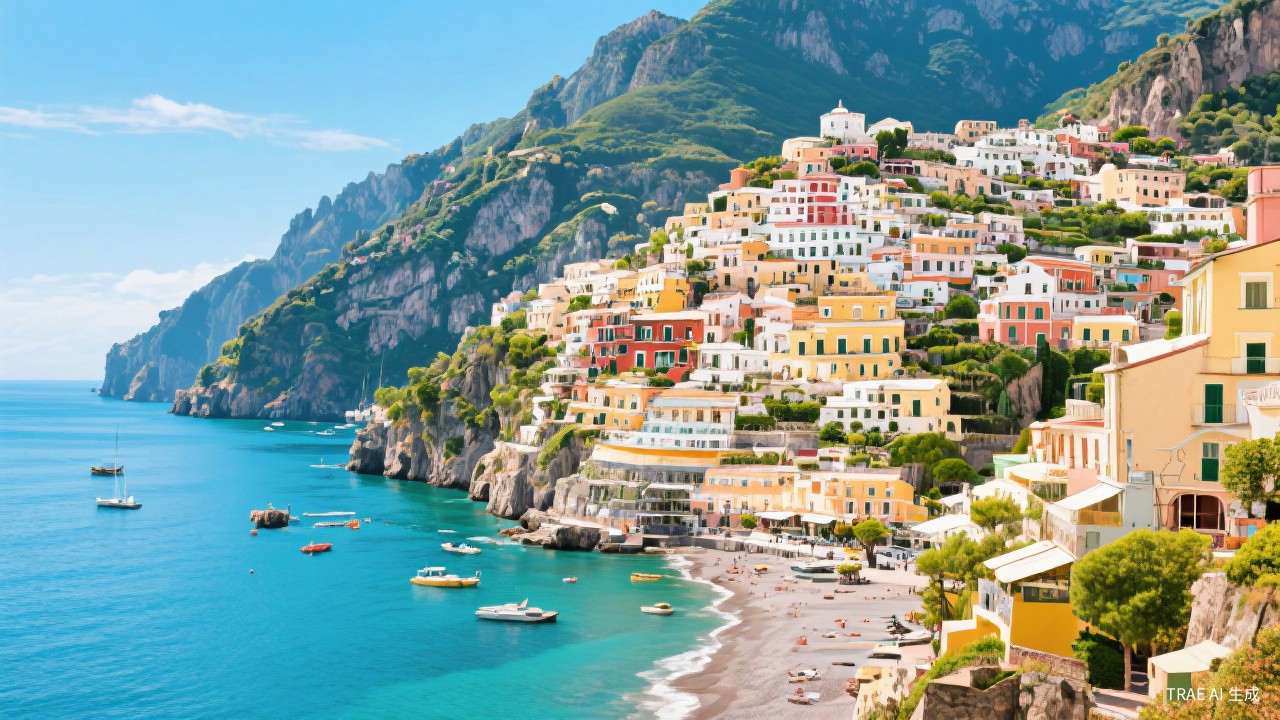
The Real Amalfi Coast
When I first drove along the Amalfi Coast, I understood why this stretch of Italy has captivated travelers for generations. The SS163 highway winds through Positano, Praiano, Amalfi, and Ravello, each town offering its own character. Positano's cascade of pink and terracotta houses tumbling toward the beach is one of Italy's most photographed scenes, while Ravello's hilltop gardens provide panoramic views that have inspired composers and writers for centuries. I found that the Sentiero degli Dei (Path of the Gods) hiking trail connects Agerola to Nocelle, passing through lemon groves and offering views of the Li Galli islands.
Life here moves at a slower pace dictated by the seasons. My first impression was watching fishermen head out early from Marina Grande, while elderly women hung laundry between the narrow alleyways of Amalfi's old quarter. The local limoncello, made from the region's enormous Sfusato Amalfitano lemons, is produced by families who have perfected their recipes over generations. In the evening, the seafront promenades fill with locals enjoying passeggiata—the traditional Italian stroll—while the scent of fresh seafood grilling mingles with salt air.
I recommend planning at least four days to explore properly. Spring (May to June) and early autumn (September to October) offer warm temperatures without the July and August crowds. Rent a small car or use the SITA buses that connect the towns, but be prepared for narrow roads and limited parking. Book accommodations well in advance, especially in Positano and Ravello. Take a ferry from Salerno or Positano to reach towns by sea—it is often faster and far more scenic than driving.
Best Time to Go
May through mid-June and September through mid-October are the ideal windows. Temperatures start at 18 to 25 degrees Celsius, the sea is warm enough for swimming by late May, and the lemon groves are in full bloom during spring. These shoulder months mean you can actually find a spot on the beach at Spiaggia Grande in Positano without arriving at dawn.
July and August bring temperatures above 30 degrees and enormous crowds—the road between Positano and Amalfi can become a parking lot. The Ravello Festival runs from June through August, featuring classical music concerts in Villa Rufolo's cliffside gardens. November to March is quiet; many hotels and restaurants close, but the winter light on the cliffs has its own appeal, and room rates drop by 40 to 60 percent.
Getting There and Around
The nearest major airport is Naples International Airport (NAP), about 75 kilometers from the coast. From Naples, the most convenient option is a private transfer or the Curreri Viaggi bus to Sorrento (around €10, 75 minutes), then a SITA bus or ferry onward. The Circumvesuviana train from Naples to Sorrento costs €5.60 and takes roughly 70 minutes. From Sorrento, SITA buses run along the SS163 to Positano (€2.20), Amalfi (€3.60), and Ravello (€4.00).
Ferries operate from April through October. Travelmar and Positano Jet connect Salerno, Amalfi, Positano, and Capri. A one-way ticket from Salerno to Positano costs about €18 and takes 35 minutes. Driving is possible but not recommended for first-time visitors—the road is extremely narrow, parking is scarce (€2 to €5 per hour), and Italian drivers approach these curves with alarming confidence.
Where to Stay
Positano is the most famous and most expensive base. Expect to pay €180 to €400 per night for a double room with a sea view. Boutique hotels like Hotel Le Sirenuse sit on the cliffside with direct beach access. The area around Spiaggia Grande is convenient but noisy in summer. For quieter stays, look at Fornillo beach on the western edge of town.
Amalfi town offers better value, with doubles from €100 to €250 per night. Stay near the Piazza del Duomo for easy access to restaurants and the ferry terminal. The town is flatter than Positano, making it easier to walk around. Atrani, the next village over, is a 10-minute walk from Amalfi and feels like a secret—rooms start around €80 per night.
Ravello sits 350 meters above sea level and is famous for its peace and gardens. Hotels here start at €120 to €300 per night. Villa Cimbrone and Villa Rufolo both have hotel wings with terraces overlooking the coast. The trade-off is that you must descend by bus or car to reach the beach—a 30-minute winding ride.
Must-See Attractions
Path of the Gods (Sentiero degli Dei)
This seven-kilometer hiking trail runs from Agerola to Nocelle, following the ridge high above the coast. The path passes through ancient olive groves and terraced vineyards, with constant views of the sea and the Capri island group on clear days. Allow three to four hours one way, then take the bus from Nocelle down to Positano. Wear proper shoes—the trail is rocky and steep in sections.
Cost: Free | Open: Always open
Villa Rufolo Gardens
Perched on a cliff edge in Ravello, these 12th-century gardens belong to a former Arab-Norman villa. The stone terraces drop dramatically toward the sea, and Wagner composed part of Parsifal here. In summer, the gardens host the Ravello Festival concerts. The views from the lower terrace are among the most photographed on the entire coast.
Cost: €7 | Open: 9 AM to 7 PM daily, April to October
Emerald Grotto (Grotta dello Smeraldo)
This sea cave near Conca dei Marini gets its name from the emerald-green light that fills the interior, caused by sunlight refracting through an underwater opening. Rowboat guides take visitors inside to see the stalactites and rock formations. The cave is small—visits last about 20 minutes—but the color effect is genuinely striking.
Entry: €10 including rowboat | Open: 9 AM to 4 PM daily
Amalfi Cathedral (Duomo di Sant'Andrea)
The 9th-century cathedral dominates Amalfi's main square with its striped Arab-Norman facade and 62-step staircase. Inside, the Cloister of Paradise features Arab-style arches surrounding a tranquil garden. The crypt houses the remains of Saint Andrew. The museum upstairs displays medieval artifacts from the Republic of Amalfi, once a major maritime power.
Tickets: €3 for museum and cloister | Open: 10 AM to 5 PM, closed Sundays in winter
Fiordo di Furore
This hidden fjord-like inlet cuts into the cliffs between Praiano and Conca dei Marini. A tiny fishing village huddles at the base of towering rock walls, and a small pebble beach appears at low tide. The viewpoint on the SS163 highway above the fjord is a popular photo stop. Each July, the fjord hosts an international diving competition where athletes leap from the rock bridge.
Cost: Free from viewpoint; beach access limited | Open: Always open
Food and Drink
Scialatielli ai Frutti di Mare — Fresh handmade pasta with locally caught seafood—shrimp, clams, and mussels tossed in a garlic and white wine sauce. Try it at Trattoria da Gemma in Amalfi, a family-run spot that has been serving the same recipes since the 1960s.
Limoncello di Amalfi — The Amalfi Coast's signature liqueur, made from Sfusato Amalfitano lemons steeped in pure alcohol. Visit the Limoncello factory in Minori for a free tasting and to see the production process. Buy a bottle to take home—prices start at €8 to €15 depending on quality.
Delizia al Limone — A sponge cake shaped like a lemon, filled with crema pasticciera and limoncello cream, then glazed. Every pasticceria on the coast has its own version. Pasticceria Pansa in Amalfi, operating since 1860, makes one of the best.
Colatura di Alici on Spaghetti — An anchovy sauce from Cetara, a fishing village west of Amalfi. The amber liquid is made by aging anchovies in salt for months, then pressing the extract. Tossed with spaghetti, garlic, and olive oil, it is intensely savory. Order it at Ristorante Al Convento in Cetara.
Practical Tips
• The SITA bus along the coast is cheap but gets extremely crowded in summer. Board at the first stop in your town to secure a seat.
• Wear comfortable shoes with good grip—the towns are built on steep hills with uneven stone steps and polished marble walkways.
• Many restaurants add a coperto (cover charge) of €2 to €4 per person. This is standard and not a scam.
• Fill a water bottle from the public fountains found in every town. The water is safe and cold.
• If driving, rent the smallest car available. Parking spots are tight and some garages cannot accommodate SUVs.
Traveler's Tip
Take the ferry between towns instead of the bus whenever possible. You avoid the traffic, get a completely different perspective of the coastline, and the ticket costs roughly the same as the bus.