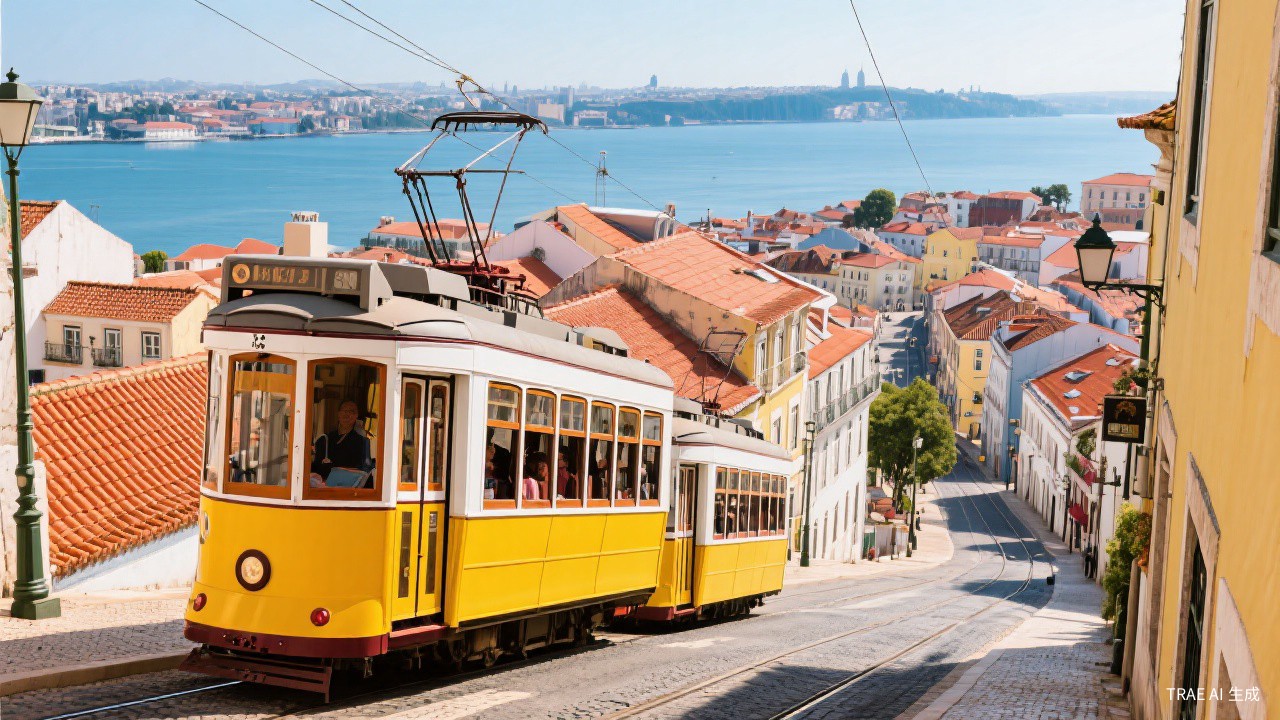
The Real Lisbon
Lisbon is built on seven hills overlooking the Tagus River, and its topography gives the city its character. The Alfama district, the oldest neighborhood, is a maze of narrow streets, tiled facades, and laundry lines stretching between buildings. The 28 tram rattles through Alfama's steep streets, past the Sao Jorge Castle and down to the waterfront. Belem, to the west, holds the Jeronimos Monastery—a UNESCO World Heritage Site with Manueline Gothic architecture—and the Torre de Belem, a 16th-century fortified tower standing in the river.
Lisbon has a melancholic beauty captured in the Portuguese concept of saudade—a longing for something lost. Fado music, the soulful genre born in Alfama's taverns, expresses this feeling through voice and Portuguese guitar. The city's food culture is built on bacalhau (salt cod), which locals claim can be prepared in 365 different ways. Pastel de nata, the custard tart invented by monks at the Jeronimos Monastery, is Lisbon's most famous export.
Three to four days is ideal. Spend day one in Alfama and Baixa. Day two covers Belem. Day three explores Bairro Alto, Chiado, and Principe Real. Day four can include Sintra or Cascais. Lisbon is walkable but hilly—wear comfortable shoes and use the iconic elevadores (funiculars) and trams.
Best Time to Go
March to May and September to November offer the best weather, with temperatures from 15 to 25 degrees. Spring brings wildflowers to the hillsides and fewer tourists. September is warm and pleasant, with the NOS Alive music festival in Oeiras. These months also offer better prices—hotels are 20 to 30 percent cheaper than in summer.
June is festive—Santo Antonio (Lisbon's patron saint) is celebrated on June 12 to 13 with parades, sardine grilling on the streets, and music in every neighborhood. July and August are hot (28 to 35 degrees) and crowded. Winter (December to February) is mild (10 to 15 degrees) and rainy, but the city's cafes and Fado houses are cozy.
Getting There and Around
Lisbon Airport (LIS) is 7 kilometers north of the center. The metro Red Line connects the airport to Saldanha station in 20 minutes for €1.90. The Aerobus runs to Baixa and Cais do Sodre for €3.60. Taxis cost about €15 to €20. Uber and Bolt are widely available and cheaper than taxis.
Lisbon's metro has four color-coded lines. A single ticket is €1.90, and a 24-hour pass is €6.40. The iconic Tram 28 costs the same as a regular ticket but is often too crowded to board. The elevadores (Santa Justa, Gloria, Bica) cost €3.80 each or are included with the 24-hour pass. The Cascais train from Cais do Sodre runs to Cascais in 40 minutes for €2.25.
Where to Stay
Alfama is the most atmospheric neighborhood, with rooms from €50 to €180 per night. The narrow streets and tiled buildings are beautiful, but the hills are steep and the area can be noisy. Stay near the Sao Jorge Castle for the best views. Baixa, the flat downtown area, is more convenient and has hotels from €60 to €200 per night.
Bairro Alto and Chiado are the cultural and nightlife centers. Hotels start at €70 to €220 per night. Chiado is more elegant, with bookshops, cafes, and the Brasileira coffee house. Bairro Alto is louder at night but livelier. Principe Real, west of Bairro Alto, is quieter and more residential, with rooms from €80 to €250 per night.
Belem, west of the center, is quieter and home to the major monuments. Hotels start at €60 to €180 per night. The area is flat and pleasant for walking, but it is a 20-minute tram ride from the center.
Must-See Attractions
Jeronimos Monastery
A UNESCO World Heritage Site and masterpiece of Manueline Gothic architecture, built in the early 16th century to celebrate Vasco da Gama's voyage to India. The cloisters are the highlight—two levels of delicate stone carving featuring maritime motifs, coats of arms, and botanical elements. The church contains the tombs of da Gama and the poet Luis de Camoes.
Tickets: €12 | Open: 10 AM to 5:30 PM, October to April; 10 AM to 6:30 PM, May to September
Sao Jorge Castle
Perched on Lisbon's highest hill, this Moorish castle dates to the 11th century and offers panoramic views over the city, the Tagus River, and the Ponte 25 de Abril bridge. The castle walls enclose olive trees, archaeological ruins, and a small museum. The neighborhood of Alfama stretches below. Arrive early to avoid crowds and enjoy the views in peace.
Admission: €10 | Open: 9 AM to 9 PM, March to October; 9 AM to 6 PM, November to February
Torre de Belem
A 16th-century fortified tower standing on a small island in the Tagus River, built to defend Lisbon's harbor. The Manueline decoration includes stone ropes, carved shields, and a rhinoceros gargoyle. Climb the narrow spiral staircase for views of the river and the Jeronimos Monastery. The tower is one of Portugal's most photographed monuments.
Tickets: €8 | Times: 10 AM to 6:30 PM, May to September; 10 AM to 5:30 PM, October to April
National Tile Museum (Museu do Azulejo)
Housed in a 16th-century convent, this museum traces the history of Portuguese azulejo (painted tiles) from the 15th century to the present. The collection includes a massive 23-meter panoramic tile panel depicting Lisbon before the 1755 earthquake. The convent church has gilded woodwork and blue-and-white tile altarpieces.
Entry: €5 | Times: 10 AM to 6 PM, Tuesday to Sunday
LX Factory
A creative complex in a converted industrial area under the Ponte 25 de Abril bridge. The space contains restaurants, design shops, bookstores, and art galleries. The Ler Devagar bookstore looks stunning in Europe. The food scene here is excellent and more affordable than central Lisbon. Open daily.
Admission: Free to enter | Times: 10 AM to 8 PM Monday to Saturday; 10 AM to 6 PM Sundays
Food and Drink
Pastel de Nata at Pasteis de Belem — The custard tart invented by monks at the Jeronimos Monastery, baked with a flaky crust and a caramelized top. Pasteis de Belem has been making them since 1837 using the original recipe. Eat them warm, dusted with cinnamon. The queue moves quickly.
Bacalhau a Bras — Salt cod scrambled with eggs, onions, and thin potato sticks, topped with black olives. This is one of Lisbon's most popular bacalhau preparations. Try it at Ramiro, a legendary seafood restaurant in the Intendente area—also order percebes (goose barnacles) if available.
Bifana — A thin pork steak marinated in garlic and white wine, served in a crusty roll with mustard. It is Lisbon's favorite sandwich. The best bifanas are found at small hole-in-the-wall shops—Bifana do Afonso in the Alcântara neighborhood is a local favorite. A bifana and a beer cost under €6.
Ginjinha — A sour cherry liqueur served in a tiny chocolate cup. A Ginjinha, the bar in Rossio Square where the drink was invented in 1840, still serves it for €1.50. Stand at the counter, knock it back, and eat the chocolate cup. It is a Lisbon ritual.
Practical Tips
• Portugal uses the euro. Lisbon is one of Western Europe's most affordable capitals.
• The Tram 28 is a tourist trap—it is often too full to board. Take it early in the morning or walk the route instead.
• Wear comfortable shoes with grip. Lisbon's cobblestones are slippery when wet.
• Fado houses in Alfama charge €25 to €40 for a show with a drink. Book ahead for the best venues.
• The Lisboa Card (€20 for 24 hours) includes public transport and museum entries. Calculate whether it suits your itinerary.
Traveler's Tip
Take the train to Sintra (40 minutes, €2.25) and spend a day exploring the fairy-tale palaces. The Pena Palace, perched on a hilltop with colorful walls and terraces, is unlike anything else in Europe. Combine it with a walk to the westernmost point of continental Europe at Cabo da Roca.