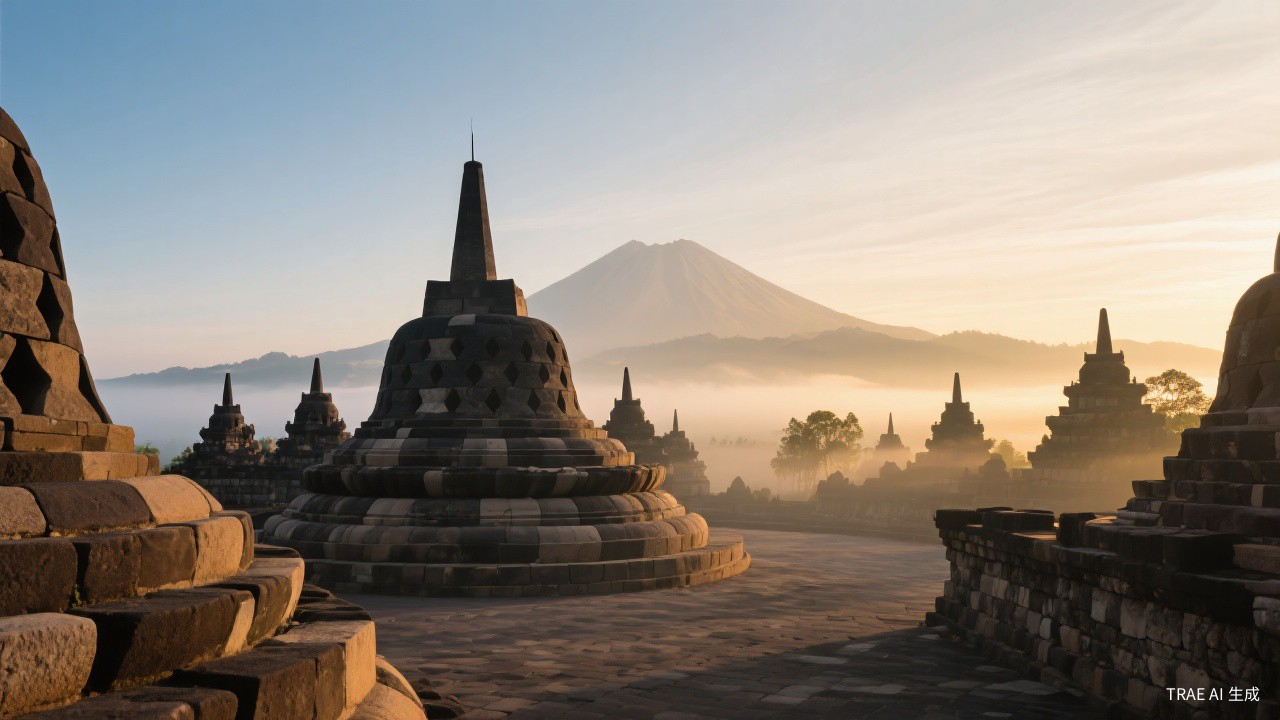
What Makes Borobudur Worth Visiting
When I first saw Borobudur at sunrise, I understood why this 9th-century monument is considered the world's largest Buddhist temple. Built from 2 million stone blocks on a hill in central Java, the temple consists of nine stacked platforms—six square and three circular—crowned by a central dome. I found that the walls and balustrades are decorated with 2,672 relief panels and 504 Buddha statues, making it the most richly decorated Buddhist monument on earth.
Walking clockwise around each level, I found that the reliefs tell a deep story. The lower levels depict scenes of earthly desire and karma from Buddhist texts. The middle levels show the life of the Buddha in his previous incarnations. The upper circular terraces contain 72 perforated stupas, each housing a Buddha statue, and represent the Buddhist concept of formlessness. Reaching the top platform, with views of the surrounding plains, rice paddies, and volcanic mountains, was the physical and spiritual culmination of my ascent.
I recommend planning one full day, ideally starting before dawn. The sunrise tour (departing Jogja at 3:30 to 4 AM) arrives at Borobudur before first light, and watching the sun rise over the temple and the surrounding volcanoes from the upper terraces is one of Indonesia's most memorable experiences. After exploring the temple, visit the nearby Mendut and Pawon temples, which form a pilgrimage route with Borobudur.
Best Time to Go
April to October is the dry season and the best time to visit. May to September offers the clearest skies for sunrise, with temperatures between 22 and 30 degrees Celsius. The dry season means less risk of the sunrise being obscured by clouds. June and July are the busiest months—arrive early to avoid crowds.
November to March is the rainy season, with heavy afternoon showers. Sunrise tours still run but may be cloudy. The surrounding rice paddies are at their greenest during the wet season. January and February are the wettest months. The temple is less crowded during the rainy season, and hotel rates in the area drop.
Getting There and Around
Borobudur is 40 kilometers northwest of Yogyakarta, about 1.5 hours by road. Most visitors base themselves in Jogja and take a sunrise tour (IDR 350,000 to 600,000 per person, including hotel pickup, entrance fee, and guide). The tour departs Jogja at 3:30 to 4 AM. Public buses from Jogja's Giwangan terminal to Borobudur take 2 hours and cost IDR 30,000. A private car with driver from Jogja costs IDR 500,000 to 700,000 per day.
The temple site is walkable, but the surrounding area is best explored by motorbike or car. Ojek (motorcycle taxi) rides from nearby hotels to the temple cost IDR 10,000 to 20,000. Bicycles can be rented from guesthouses for IDR 50,000 per day to explore the villages and rice paddies around the temple. The Mendut and Pawon temples are 3 and 2 kilometers from Borobudur, respectively, and can be reached by ojek.
Where to Stay
The area immediately around Borobudur has several hotels and guesthouses. The Manohara Hotel (IDR 800,000 to 1,500,000 per night) is the closest to the temple and offers sunrise access through a private gate. The Plataran Borobudur (IDR 2,000,000+) is a luxury resort with volcano views and a pool. Mid-range options like the Saraswati Borobudur (IDR 300,000 to 600,000) offer comfortable rooms within walking distance.
For a more immersive experience, several homestays in the surrounding villages offer rooms from IDR 150,000 to 300,000 per night. The village of Wanurejo, 2 kilometers from the temple, has several well-regarded homestays where you can experience rural Javanese life. Most include breakfast and can arrange cooking classes or rice terrace walks.
Must-See Attractions
Borobudur Temple at Sunrise
The sunrise experience begins in the dark, with flashlights guiding visitors up the steep stone steps to the upper terraces. As dawn breaks, the temple's silhouette emerges against a sky that turns pink, orange, and gold. The surrounding peaks of Mount Merapi and Mount Merbabu become visible, and the morning mist settles in the valleys below. The 72 perforated stupas on the upper terraces catch the first light, each framing a Buddha statue.
Cost: IDR 375,000 (foreigners, includes flashlight) | Hours: Sunrise tours from 4:30 AM; regular entry 6 AM-5 PM
Mendut Temple
Located 3 kilometers east of Borobudur, Mendut is a 9th-century Buddhist temple that predates Borobudur. The temple houses three large stone Buddha statues: a 3-meter seated Dhyani Buddha, flanked by Boddhisattvas Avalokiteshvara and Vajrapani. The temple is part of the traditional Buddhist pilgrimage route that includes Pawon and Borobudur. The grounds are peaceful and shaded by large trees.
Entry: Included in Borobudur ticket | Hours: Daily 6 AM-5 PM
Pawon Temple
A small but elegant 9th-century Buddhist temple located between Mendut and Borobudur, connected by a straight stone pathway. The temple's precise position between the two larger temples suggests it served as a ritual waypoint on the pilgrimage route. The reliefs on the outer walls depict Buddhist motifs and kalpataru (tree of life) symbols.
Entry: Included in Borobudur ticket | Times: Daily 6 AM-5 PM
Setumbu Hill Sunrise Viewpoint
For an alternative sunrise view, hike 20 minutes up Setumbu Hill, 2 kilometers from Borobudur. From the top, you see Borobudur in the valley below, surrounded by rice paddies and with Mount Merapi smoking in the distance. The view is wider than from the temple itself, though you miss the experience of being among the stupas.
Entry: IDR 15,000 | Hours: Daily 4:30 AM-6 PM
Wanurejo Village and Rice Terraces
The village of Wanurejo, near Borobudur, offers a glimpse into rural Javanese life. Walk through rice paddies, visit a traditional Javanese home, and see how locals make tempeh and tofu. Several community-based tourism programs offer guided village walks (IDR 50,000 to 100,000) that include a home-cooked lunch. The pace is slow and the interactions are genuine.
Admission: Village walk IDR 50,000-100,000 | Hours: Daily, arrange through guesthouses
Food and Drink
Nasi gudeg (jackfruit curry with rice and chicken) — Warung Bu Wiryo, Borobudur village. IDR 20,000-35,000.
Tempeh mendoan (thin fried tempeh with batter) — Street stalls near Borobudur entrance. IDR 5,000-10,000.
Javanese coffee (kopi jawa) — Toko Kopi near Mendut Temple. IDR 8,000-15,000.
Sate kelinci (rabbit satay with peanut sauce) — Sate Kelinci Pak Dhe, Borobudur area. IDR 25,000-40,000.
Practical Tips
Book the sunrise tour through your hotel or a reputable agency—the early start is worth the effort.
Bring a flashlight for the pre-dawn climb up the temple steps.
• Wear comfortable shoes with good grip—the stone steps are steep and can be slippery.
• The temple gets very hot by mid-morning—bring water and a hat.
• Hire a guide at the temple entrance (IDR 100,000) to understand the relief panels.
Traveler's Tip
After the sunrise crowds leave Borobudur (around 8 AM), walk to the nearby village of Wanurejo and ask a local to take you to the Selogriyo rice terraces, a 30-minute motorbike ride into the hills. The terraces are far less visited than those around Jogja, and you will likely have them entirely to yourself. The walk through the paddies takes about an hour, with views of Mount Sumbing in the distance.