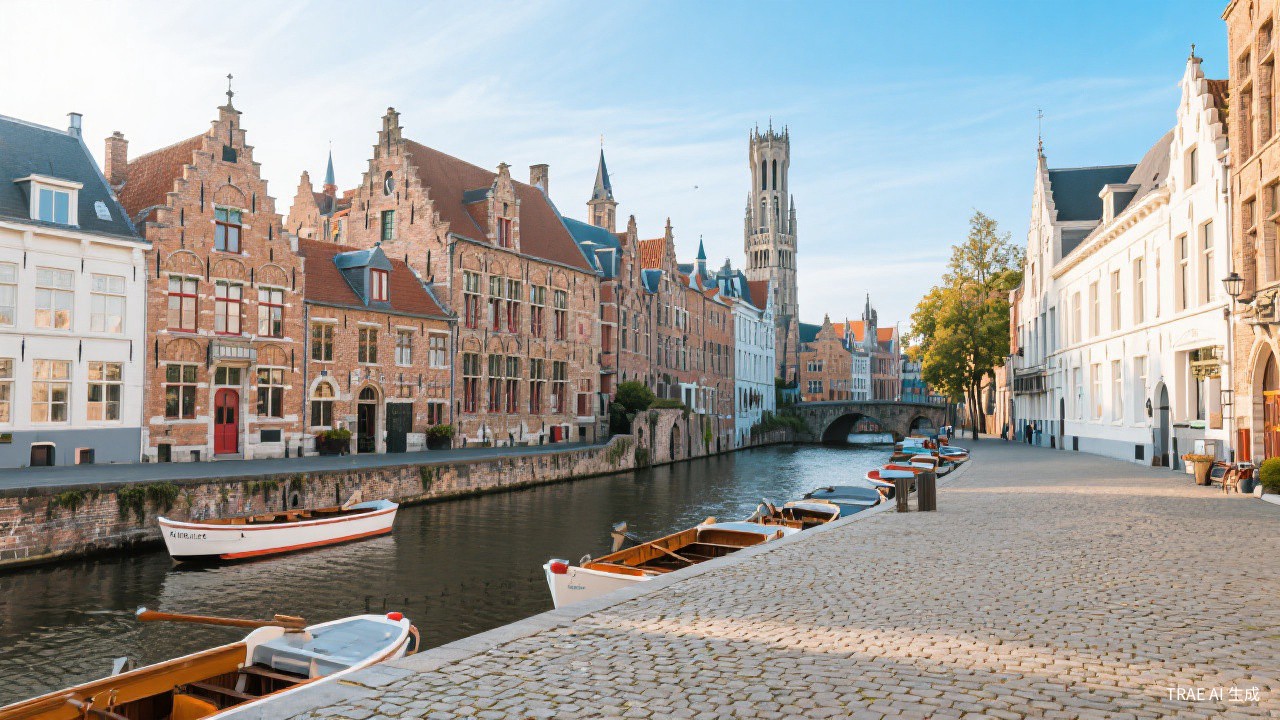
What You Will Find in Bruges
I spent my first hours in Bruges walking, I felt like I had stepped back in time. This is one of the best-preserved medieval cities in Europe, its center virtually unchanged since the 15th century when it was one of the wealthiest trading ports in the world. The Markt square, dominated by the 83-meter Belfry, looks like a painting by Jan van Eyck—and indeed, the city was home to the Flemish Primitives who revolutionized European painting. I found that canals thread through the center, crossed by arched stone bridges and lined with step-gabled houses.
Life in Bruges moves slowly, and that is part of the appeal. My first morning, I watched bakers open early with fresh bread and speculoos, while chocolate shops displayed their wares like jewelry. The city has a population of only 120,000, and the center feels like a village. In the evening, when the day-trippers leave, the streets go quiet except for the sound of horse-drawn carriages on cobblestones and the occasional church bell.
I recommend spending two full days to see the main sights. Start with the Markt, climb the Belfry, and visit the Burg square with the Stadhuis (City Hall) and the Basilica of the Holy Blood. Take a canal boat tour, visit the Church of Our Lady, and explore the Beguinage. Reserve time for chocolate tasting—The Chocolate Line, Dumon, and Dominique Persoone are all worth visiting. Bruges is compact and entirely walkable.
Best Time to Go
April to June and September to October are ideal. Spring temperatures start at 10 to 20 degrees, and the city's gardens are in bloom. The Procession of the Holy Blood, held on Ascension Day (40 days after Easter), dates to the 13th century and features costumed participants carrying a relic through the streets. September brings the Bruges Beer Festival and pleasant outdoor dining weather.
July and August are warm (18 to 25 degrees) but crowded with day-trippers. Arrive early to enjoy the main squares before the tour groups. Winter is cold (2 to 8 degrees) but atmospheric—the Christmas market in the Markt is one of Belgium's best, with an ice rink and mulled wine stalls. Hotel prices drop 30 to 40 percent from November to March.
Getting There and Around
Bruges has no airport. The nearest is Brussels Airport (BRU), about 100 kilometers away. From Brussels, take the train to Bruges: the SNCB runs direct services every 30 minutes, taking about one hour for €16.50. Eurostar connects London to Brussels in two hours, and Thalys connects Paris to Brussels in 1 hour 22 minutes.
Bruges is small enough to explore entirely on foot. The train station is about 20 minutes from the center on foot, or you can take bus lines 1, 3, or 13 (€3). Bicycles are available for rent at the station and throughout the city for about €10 per day. Canal boat tours depart from several docks and cost €12 for a 30-minute ride. Horse-drawn carriage tours cost €45 for a 30-minute ride.
Where to Stay
The area around the Markt and Burg squares is the most convenient. Hotels here start at €100 to €250 per night. You pay for location—the main sights are steps away, and restaurants are plentiful. The Hotel Heritage and Hotel Dukes' Palace are both excellent upscale options.
The area around 't Zand square, 10 minutes west of the Markt, offers slightly better value with rooms from €70 to €180 per night. The square hosts a Saturday market and is close to the Concertgebouw (concert hall). The streets around the Beguinage are quiet and residential, with guesthouses from €60 to €140 per night.
For budget travelers, hostels in Bruges start at €25 per night. The Snuffel Backpacker Hostel near the center is well-regarded. Bruges is small enough that staying slightly outside the center saves money without sacrificing convenience.
Must-See Attractions
The Belfry of Bruges
The 83-meter medieval bell tower dominates the Markt square. Climbing the 366 steps to the top takes about 15 minutes and rewards you with a panoramic view of the red-roofed city. The tower houses a 47-bell carillon that plays concerts on summer evenings. The narrow spiral staircase is challenging—stop at the intermediate levels to catch your breath.
Cost: €14 | Times: 9:30 AM to 5 PM daily
Basilica of the Holy Blood
A 12th-century chapel on the Burg square that houses a vial of Christ's blood, brought to Bruges after the Second Crusade. The lower chapel is Romanesque, while the upper chapel was rebuilt in Gothic style. The relic is displayed daily and blessed in a ceremony. Whether or not you are religious, the chapel's stained glass and gilded decoration are remarkable.
Tickets: Free | Times: 10 AM to 12 PM, 2 PM to 4 PM
Church of Our Lady (Onze-Lieve-Vrouwekerk)
This 13th-century church houses Michelangelo's Madonna and Child sculpture, one of the artist's few works to leave Italy during his lifetime. The church also contains the ornate tombs of Charles the Bold and Mary of Burgundy. The 122-meter brick tower is the second tallest in Belgium. The interior is relatively austere, which makes the Michelangelo stand out more.
Admission: €6 | Hours: 10 AM to 5 PM, closed Sundays for services
The Beguinage (Begijnhof)
A UNESCO World Heritage Site, this complex of white-fronted houses surrounding a green courtyard was founded in 1245 as a residence for Beguines—lay religious women who lived communally without taking vows. Today it houses Benedictine nuns. The entrance is through a stone archway, and the garden stands out as peaceful spots in Bruges.
Tickets: Free | Open: 6:30 AM to 6:30 PM daily
Choco-Story Chocolate Museum
Located in a 15th-century building, this museum traces the history of chocolate from the Maya to modern Belgian pralines. Demonstrations show how chocolate is tempered and molded. Tastings are included throughout the visit. It takes about 90 minutes and is worth it for anyone interested in Belgium's chocolate tradition.
Tickets: €11 | Hours: 10 AM to 5 PM daily
Food and Drink
Belgian Chocolate Pralines — Bruges has dozens of chocolate shops, but The Chocolate Line on the Markt is the most innovative. Dominique Persoone creates flavors like wasabi, Havana cigar, and bacon chocolate. For traditional pralines, visit Dumon on Eiermarkt—their buttercream fillings are exceptional.
Moules-Frites — Mussels steamed in white wine, celery, and butter, served with crispy fries and mayonnaise. Poules Moules on the Vlamingstraat is a local favorite, serving mussels in a dozen different preparations. A pot of mussels costs about €18 and is enough for a full meal.
Brugse Zot Beer — The only beer still brewed in Bruges, at the De Halve Maan brewery. The blond ale (6% ABV) is light and fruity; the dubbel (8% ABV) is darker and more complex. Take a brewery tour (€10) that ends with a tasting on the roof with city views. The brewery delivers beer through underground pipes to a bottling plant outside the center.
Belgian Waffles — Bruges specializes in the Brussels-style waffle—light, crispy, and rectangular, topped with cream, chocolate, or fresh fruit. Lizzie's Wafels on the Katelijnestraat makes them fresh to order. A plain waffle costs about €3; loaded versions run €5 to €7.
Practical Tips
• Bruges is extremely walkable, but the cobblestones are hard on feet. Wear comfortable shoes.
• The city fills with day-trippers between 10 AM and 5 PM. Visit major attractions early or late to avoid crowds.
• Belgian fries (frites) are taken seriously. Buy them from a frituur (fry shop) rather than a restaurant—De Steeghse Frituur is excellent.
• Many shops close on Sundays. Plan shopping for weekdays.
• The Bruges City Card (€49 for 48 hours) includes museum entries, canal boat tours, and bus rides. Calculate whether you will visit enough sites to justify it.
Traveler's Tip
Stay overnight rather than visiting as a day trip. By 6 PM, the tour groups are gone, the streets empty, and Bruges becomes the quiet medieval town it really is. Have dinner at a restaurant overlooking a canal, then walk home through lamplit squares. The difference is remarkable.