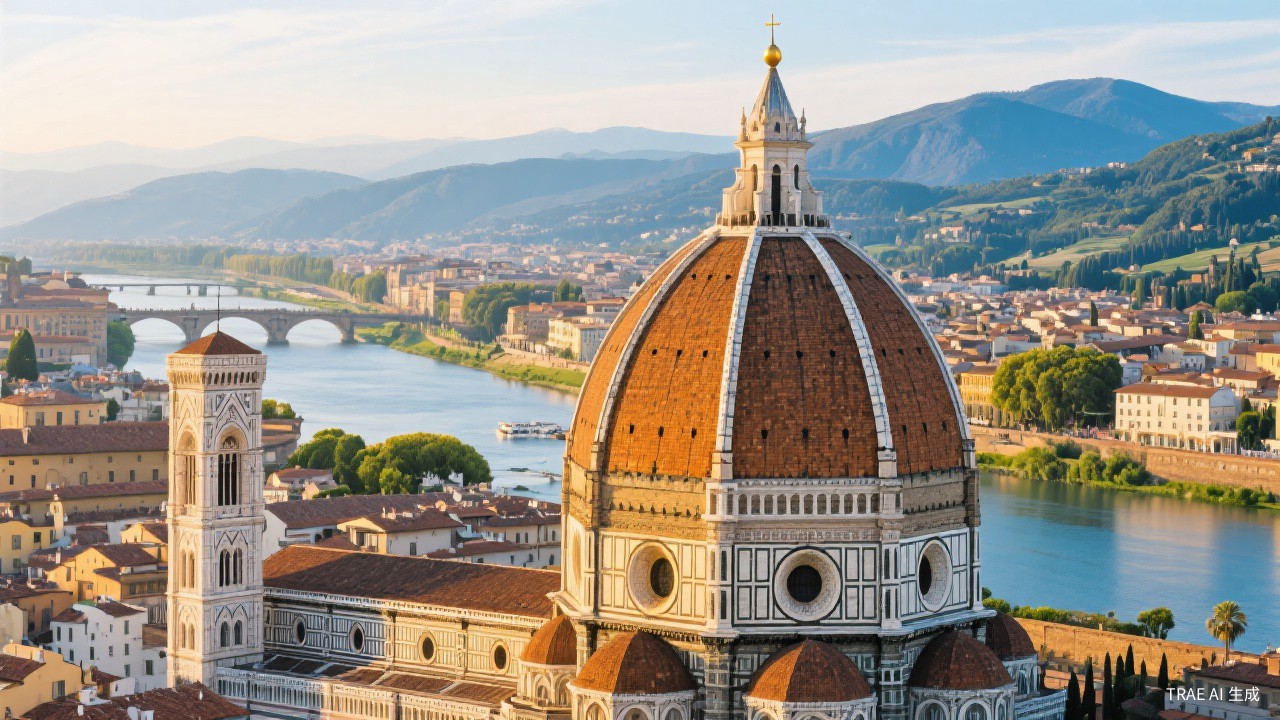
First Impressions of Florence
Florence was the birthplace of the Renaissance, and the city's artistic heritage is overwhelming in its concentration. The Uffizi Gallery holds the world's greatest collection of Italian Renaissance art, including Botticelli's Birth of Venus and Primavera, Leonardo da Vinci's Annunciation, and works by Michelangelo, Raphael, and Caravaggio. The Accademia Gallery houses Michelangelo's David, a 5.17-meter marble sculpture that is more impressive in person than any photograph suggests. Brunelleschi's terracotta dome on the Duomo dominates the skyline and remains the largest masonry dome ever built.
Florence is also a culinary capital. Tuscan cuisine is built on simplicity and quality ingredients: bistecca alla fiorentina (a massive T-bone steak grilled over charcoal), ribollita (a hearty bread and vegetable soup), and panzanella (bread salad with tomatoes). The Mercato Centrale, a two-level market in San Lorenzo, has a ground floor of produce and meat vendors and an upstairs food court with stalls selling fresh pasta, tripe sandwiches, and schiacciata (flatbread).
Two to three days is enough for the main sights. Day one: the Duomo, Baptistery, and Giotto's Bell Tower. Day two: the Uffizi and Accademia. Day three: the Oltrarno neighborhood, Pitti Palace, and the Boboli Gardens. Florence is very walkable—the entire historic center is a UNESCO World Heritage Site and can be crossed on foot in 20 minutes.
Best Time to Go
April to June and September to October are ideal. Spring temperatures start at 15 to 25 degrees, and the hills around Florence are green and covered with wildflowers. September brings the grape harvest in Chianti and pleasant temperatures for walking. These months also have shorter queues at the Uffizi and Accademia.
July and August are hot (30 to 38 degrees) and very crowded. The Uffizi queue can take two hours without a reservation. Winter (November to February) is cool (5 to 12 degrees) but atmospheric, with fewer tourists and lower prices. The Christmas market in Piazza Santa Croce adds seasonal charm.
Getting There and Around
Florence Airport (Peretola, FLR) is 5 kilometers northwest of the center. The tram T2 connects the airport to Santa Maria Novella station in 20 minutes for €1.70. Taxis cost about €20 to €25. Pisa Airport (PSA) is 80 kilometers away, connected by train (€5.80, one hour). The high-speed train from Rome takes 1 hour 20 minutes (€20 to €45).
Florence's historic center is small and best explored on foot. The main train station is Santa Maria Novella, within walking distance of the Duomo and most hotels. City buses cover areas outside the center. A single ticket is €1.70. Taxis are available but rarely needed within the center.
Where to Stay
The area around Santa Maria Novella station is the most convenient base. Hotels start at €80 to €250 per night. You are within walking distance of the Duomo, Uffizi, and San Lorenzo market. The streets around the station can be busy but are well-connected.
Oltrarno, south of the Arno River, is quieter and more authentic. Hotels and apartments start at €70 to €200 per night. The neighborhood is famous for artisan workshops (leather, gold, paper) and excellent restaurants. Santo Spirito square is the social hub. It is a 10-minute walk across the Ponte Vecchio to the center.
San Lorenzo, between the Duomo and the station, is central but can be noisy. Hotels start at €60 to €180 per night. The Mercato Centrale is here, making it a food lover's base. For luxury, stay near Piazza della Signoria or on the Lungarno (Arno riverfront), where hotels like the Lungarno Collection offer rooms from €250 to €600 per night.
Must-See Attractions
Uffizi Gallery
The world's finest collection of Italian Renaissance art, arranged chronologically in a 16th-century building designed by Giorgio Vasari. The highlights corridor includes Botticelli's Birth of Venus, Leonardo's Annunciation, Michelangelo's Doni Tondo, and Caravaggio's Medusa. The building itself, with its long corridors and views over the Arno, is remarkable. Book online in advance.
Entry: €20 to €25 depending on season | Hours: 8:15 AM to 6:50 PM, Tuesday to Sunday
Florence Cathedral (Duomo)
Brunelleschi's terracotta dome, completed in 1436, remains the largest masonry dome in the world. The exterior is clad in white, green, and pink marble. Climbing the dome (463 steps) offers views over the city and an understanding of Brunelleschi's engineering genius. The Baptistery across the square has Lorenzo Ghiberti's gilded bronze doors, which Michelangelo called the Gates of Paradise.
Tickets: Dome climb €30 combined ticket | Open: 8:30 AM to 7 PM; dome 8:30 AM to 7 PM, last entry 5:30 PM
Accademia Gallery
Home to Michelangelo's David, sculpted between 1501 and 1504 from a single block of Carrara marble. The 5.17-meter statue dominates the Tribune hall. The gallery also contains Michelangelo's unfinished Prisoners (Slaves), intended for Pope Julius II's tomb. The Hall of Musical Instruments displays Stradivari violins. Book ahead—the queue without a reservation can exceed two hours.
Entry: €16 | Hours: 8:15 AM to 6:50 PM, Tuesday to Sunday
Pitti Palace and Boboli Gardens
A vast Renaissance palace on the Oltrarno side, once home to the Medici family. The palace contains several museums: the Palatine Gallery (Raphael, Titian), the Silver Museum, and the Costume Gallery. The Boboli Gardens behind the palace are one of the earliest Italian formal gardens, with fountains, grottoes, and sweeping views over Florence.
Admission: Palace €16; gardens €10; combined €22 | Times: 8:15 AM to 6:50 PM, Tuesday to Sunday
Ponte Vecchio
Florence's oldest bridge, dating to 1345, lined with jewelry shops that have occupied the bridge since the 16th century. The Vasari Corridor, an elevated passageway, runs above the shops connecting the Uffizi to the Pitti Palace. The bridge is best viewed from the Ponte Santa Trinita or the Lungarno at sunset, when the reflected light turns the Arno River gold.
Tickets: Free | Times: Always open
Food and Drink
Bistecca alla Fiorentina — A massive T-bone steak from Chianina beef, grilled over charcoal and served rare. It is Florence's most famous dish. Trattoria Mario, open since 1953, serves one of the best versions. The steak is priced by weight—expect to pay €40 to €60 for two people to share.
Lampredotto at Da Nerbone — A tripe sandwich made from the fourth stomach of a cow, slow-cooked and served in a bun with green sauce and chili. It is Florence's most popular street food. Da Nerbone, in the Mercato Centrale, has been serving it since 1872. Eat standing at the counter like the locals.
Schiacciata all'Olio — A thin, salty flatbread baked with olive oil and salt. The version at Buca Mario, a family-run bakery on Via de' Ginori, is legendary—crispy on the outside, soft inside, and perfect with prosciutto and cheese. Buy it fresh in the morning.
Gelato at Vivoli — Florence's most famous gelateria, open since 1929. Vivoli does not serve cones—only cups. The crema (custard) and pistachio flavors are outstanding. For a more modern approach, try Gelateria dei Neri near Santa Croce, which offers flavors like ricotta and fig.
Practical Tips
Book the Uffizi and Accademia online in advance. The skip-the-line tickets are worth every cent.
Avoid restaurants with photo menus and aggressive touts on the street. The best trattorias are unmarked.
• Florence is small. You can walk from the Duomo to the Pitti Palace in 15 minutes.
• The Mercato Centrale food court upstairs is excellent and affordable for lunch. A meal costs €8 to €12.
• Florence gets very hot in summer. Carry water and plan indoor activities for midday.
Traveler's Tip
Climb Giotto's Bell Tower (414 steps) instead of the Duomo dome if you can only do one. The views are nearly as good, the queue is shorter, and you get a close-up view of Brunelleschi's dome from above. The bell tower is included in the same €30 combined ticket.