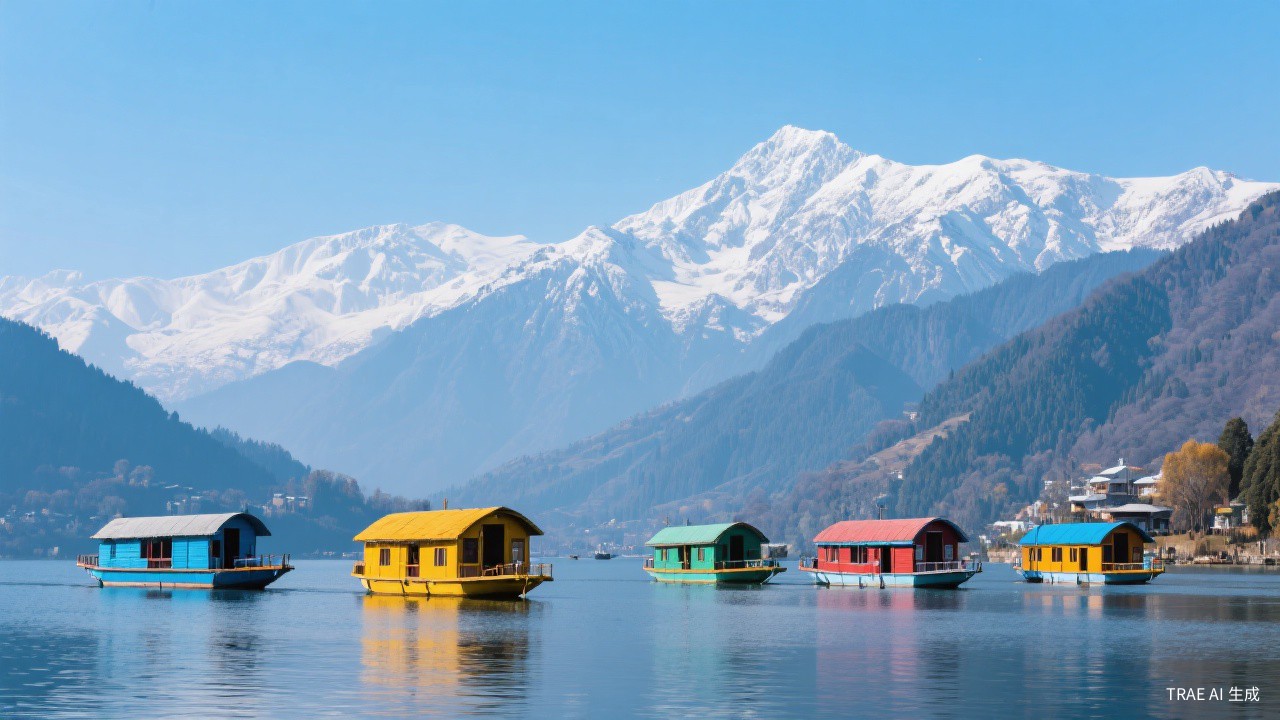
Discovering Kashmir
Kashmir has been called "Paradise on Earth" for centuries, and the description still fits. The Kashmir Valley, cradled by the Pir Panjal and Himalayan ranges, contains Dal Lake with its iconic houseboats, the Mughal Gardens along its shores, and the old city of Srinagar with its wooden mosques and copper craftsmen. Gulmarg, 50 kilometers to the west, has one of the world's highest gondola rides (3,979 meters) and transforms into a ski resort in winter. Pahalgam, to the east, serves as the base for the Amarnath Cave pilgrimage and offers some of Kashmir's most accessible mountain scenery.
Kashmiri culture is a blend of Central Asian, Persian, and Indian influences. The local cuisine features wazwan, a multi-course feast of lamb dishes cooked by specialist chefs, and the daily noon chai (pink tea with milk, salt, and cardamom) is a social ritual. Srinagar's old city, with its narrow lanes, wooden houses with overhanging balconies, and the Hazratbal Shrine on the lake, feels like a place apart from the rest of India. The shawl and papier-mache crafts are among the finest in the world, with artisans working in small workshops in the old city.
Plan seven to ten days. Spend three nights on a houseboat on Dal Lake, using Srinagar as a base for the Mughal Gardens and the old city. Dedicate two days to Gulmarg (gondola ride, golf, or skiing depending on season). Two days in Pahalgam for the Betaab Valley and Aru Valley. One day for Sonamarg and the Thajiwas Glacier if road conditions permit.
Best Time to Go
March to May is spring, when the valley's tulip gardens bloom and the almond trees blossom. Temperatures start at 10 to 25 degrees Celsius. The tulip garden in Srinagar (Asia's largest) is open from late March to mid-April. June to August is summer, with pleasant weather (20 to 35 degrees) and peak tourist season. This is the best time for trekking and visiting Ladakh via the Srinagar-Leh highway.
September to November brings autumn, with the chinar (maple) trees turning gold and red—the most photogenic season. December to February is winter, with heavy snowfall and temperatures dropping below zero. Gulmarg's ski season runs from December to March, and the frozen Dal Lake creates a surreal Scenery. Some areas become inaccessible due to snow.
Getting There and Around
Sheikh ul-Alam International Airport (SXR) in Srinagar receives direct flights from Delhi (1.5 hours), Mumbai, Bangalore, and Jammu. Flights from Delhi cost INR 4,000 to 8,000 one way. The Jammu-Tawi railway station is 300 kilometers south; the Go to Srinagar via the Jawahar Tunnel takes 8 to 10 hours. The Srinagar-Leh highway (434 kilometers) is open from June to October and is one of the world's great road trips.
Within Kashmir, hired taxis and private cars are the main transport. A taxi for a full day of sightseeing around Srinagar costs INR 2,000 to 3,000. Shared Sumo jeeps run between Srinagar, Gulmarg, Pahalgam, and Sonamarg for INR 300 to 500 per seat. Shikaras (traditional boats) on Dal Lake cost INR 200 to 500 for a one-hour ride. Auto-rickshaws are available within Srinagar city.
Where to Stay
Dal Lake houseboats are the quintessential Kashmir experience. Categories start at Standard (INR 2,000 to 4,000 per night) to Deluxe (INR 6,000 to 15,000) to Luxury (INR 20,000+). The houseboats vary in age and condition—ask to see photos before booking. The houseboats on the Boulevard side have lake views, while those on the Nigeen Lake side are quieter.
Srinagar's Lal Chowk area has hotels like the Grand Lalit (INR 8,000 to 15,000) and the Broadway Hotel (INR 4,000 to 7,000). Gulmarg has the Highlands Park (INR 8,000 to 15,000) and several guesthouses (INR 2,000 to 4,000). Pahalgam offers riverside hotels like the Pahalgam Hotel (INR 5,000 to 10,000) and budget options near the main market.
Must-See Attractions
Dal Lake and Shikara Ride
The centerpiece of Srinagar, Dal Lake covers 22 square kilometers and is home to floating gardens, markets, and over 1,000 houseboats. A shikara ride through the lake's canals passes the floating vegetable market (active at dawn), lotus gardens in summer, and the old wooden houseboats with their carved walnut-wood interiors. The Mughal Gardens (Nishat, Shalimar, and Chashme Shahi) line the eastern shore.
Cost: Shikara INR 200-500/hour | Open: Always open; market at dawn
Gulmarg Gondola
The Gulmarg Gondola is one of the highest cable cars in the world, ascending from 2,690 meters to 3,979 meters at Phase 2. The ride passes through pine forests and meadows, with views of Nanga Parbat (8,126 meters) on clear days. Phase 1 goes to Kongdoori Mountain; Phase 2 continues to Apharwat Peak. In winter, the area becomes a ski resort with runs for all levels.
Cost: Phase 1 INR 700; Phase 2 INR 900 | Times: Daily 9 AM-4 PM (weather permitting)
Mughal Gardens (Nishat Bagh and Shalimar Bagh)
The Mughal emperors built these terraced gardens along Dal Lake in the 17th century. Nishat Bagh ("Garden of Joy") has 12 terraces representing the zodiac signs, with fountains and chinar trees. Shalimar Bagh ("Abode of Love") was built by Emperor Jahangir for his wife and features black marble pavilions and a canal system. Chashme Shahi has a natural spring believed to have medicinal properties.
Admission: INR 50-100 each | Hours: Daily 9 AM-7 PM
Betaab Valley
Named after the 1983 Bollywood film "Betaab" shot here, this valley near Pahalgam is framed by snow-capped peaks, pine forests, and the Lidder River. The meadows are carpeted with wildflowers in summer. It is a popular picnic spot for local families and a base for trekking to Kolahoi Glacier. Pony rides are available along the valley trails.
Tickets: INR 50 entry | Hours: Daily 6 AM-6 PM
Old City Srinagar and Jamia Masjid
The old city's narrow lanes contain some of Kashmir's finest wooden architecture. The Jamia Masjid, built in 1400 by Sultan Sikandar, is an enormous wooden mosque with 378 pillars and a peaceful courtyard. Nearby, the Zaina Kadal bridge crosses the Jhelum River, and the copper craftsmen of the area still hammer detailed designs by hand. The Hari Parbat hill overlooks the old city.
Entry: Free | Open: Mosque daily 3-5 PM (for visitors); old city always open
Food and Drink
Wazwan feast (multi-course Kashmiri lamb dishes) — Ahdoos Restaurant, Residency Road, Srinagar. INR 800-1,500 per person.
Rogan josh and dum aloo — Mughal Darbar, Lal Chowk, Srinagar. INR 300-500.
Noon chai (pink salt tea) and baker's bread (lavasa) — Makhdoomi Sahib area, old Srinagar. INR 20-50.
Kahwa (saffron and almond tea) — Chai Jai, Boulevard Road, Srinagar. INR 50-100.
Practical Tips
Check the current security situation before visiting—conditions can change and some areas may have restrictions.
• Carry cash in Indian Rupees—ATMs are available in Srinagar but less reliable in smaller towns.
• The Srinagar-Leh highway is open only from June to October; check road conditions before traveling.
• Houseboat prices are negotiable, especially outside peak season—compare several before committing.
• Mobile internet can be unreliable in Kashmir; download offline maps before arrival.
Traveler's Tip
Wake up at 4:30 AM and take a shikara to the Dal Lake floating vegetable market. Farmers arrive in their boats before dawn, selling tomatoes, lotus stems, and melons from floating gardens. The market lasts about an hour and stands out as atmospheric experiences in India—ask your houseboat owner to arrange the boat the night before.