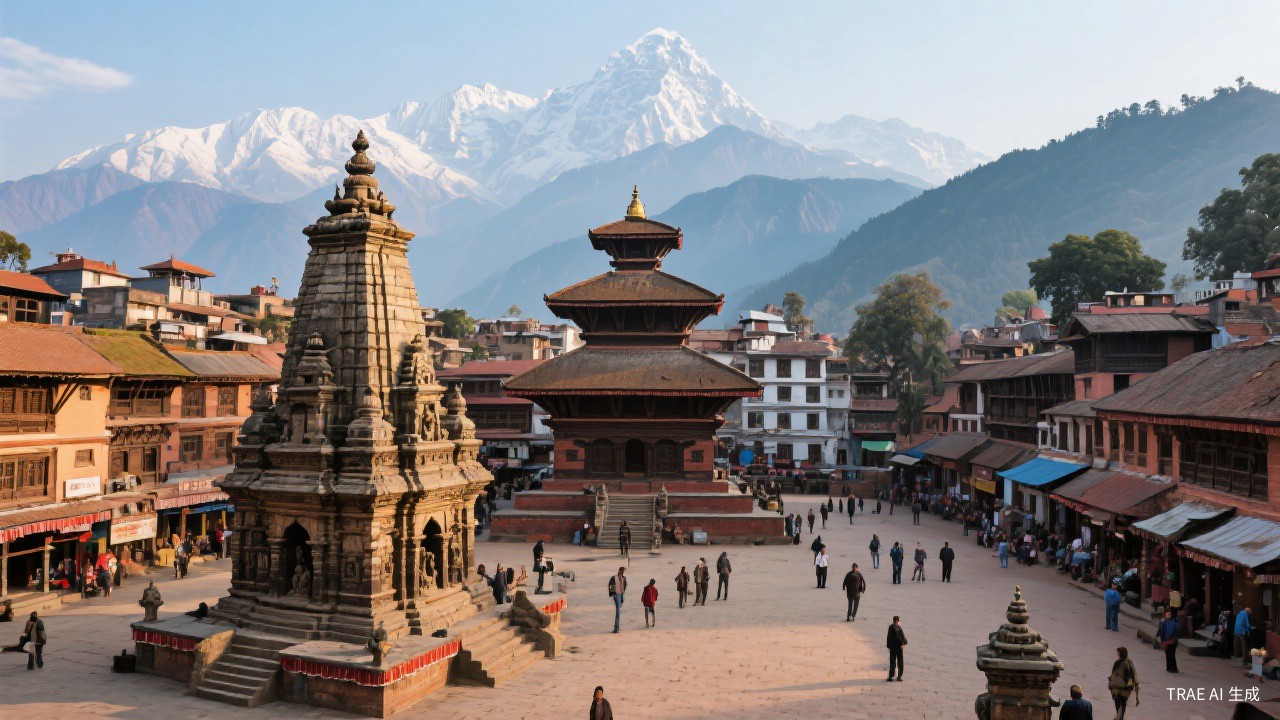
What You Will Find in Kathmandu
Kathmandu is a city where ancient temples and medieval squares sit in the shadow of the Himalayas. The Kathmandu Durbar Square, a UNESCO World Heritage Site, contains the old royal palace, the Kumari Chowk (home of the Living Goddess), and dozens of pagoda-style temples. The nearby Swayambhunath Stupa (the Monkey Temple) sits atop a hill west of the city, its all-seeing eyes painted on the golden spire visible for miles. Pashupatinath Temple, on the banks of the Bagmati River, is one of Hinduism's holiest sites, where cremation ceremonies take place openly on the riverbank ghats.
Kathmandu's old quarters—Thamel for tourists, Asan for locals—are a maze of narrow streets packed with shops selling trekking gear, singing bowls, thangka paintings, and momos (Tibetan dumplings). The city's population is a mix of Hindu and Buddhist traditions, with both religions coexisting in daily life. The Boudhanath Stupa, one of the world's largest Buddhist stupas, is surrounded by monasteries and Tibetan refugee shops. The city's cafe culture has grown rapidly, with specialty coffee roasters and bakeries catering to trekkers and expats.
Plan three to four days in Kathmandu before or after a trek. Day one: Kathmandu Durbar Square and Thamel. Day two: Swayambhunath and Pashupatinath. Day three: Boudhanath and the Patan Durbar Square across the river. Day four: Bhaktapur Durbar Square (a separate city 14 kilometers east). If time permits, the Garden of Dreams and the Kaiser Library offer quiet retreats from the city's chaos.
Best Time to Go
October to November and March to May are the best seasons. Autumn (October-November) offers clear mountain views after the monsoon, mild temperatures (15 to 25 degrees), and the major Hindu festivals of Dashain and Tihar. Spring (March-May) brings rhododendron blooms in the hills and warmer temperatures. These are peak trekking seasons, so book flights and hotels early.
December to February is cold (2 to 15 degrees) with fog that can obscure mountain views. June to September is the monsoon, with heavy daily rain, muddy streets, and limited mountain visibility. The monsoon does bring lush greenery and fewer tourists. Some trekking routes become slippery and leech-infected.
Getting There and Around
Tribhuvan International Airport (KTM) is the only international airport in Nepal, with direct flights from Delhi, Mumbai, Bangkok, Singapore, Hong Kong, Dubai, and Doha. Flights from Delhi cost INR 8,000 to 15,000. The airport is 6 kilometers from the city center; a prepaid taxi costs NPR 600 to 800. The airport is notorious for delays due to weather—build buffer time into connections.
Within Kathmandu, tempos (shared three-wheelers) and microbuses cost NPR 15 to 30 per ride. Taxis charge NPR 200 to 500 for trips within the city. Walking is the best way to explore the old quarters. For trips to Bhaktapur and Patan, local buses run from Ratna Park for NPR 20 to 30. Tourist buses to Pokhara (7 hours) cost NPR 800 to 1,500.
Where to Stay
Thamel is the tourist hub, with hundreds of hotels and guesthouses. The Kathmandu Guest House (NPR 3,000 to 6,000 per night) is a legendary backpacker institution. Mid-range options like the Hotel Vajra (NPR 5,000 to 10,000) offer more character. Thamel is noisy and touristy but incredibly convenient for trekking gear shops, travel agencies, and restaurants.
The Lazimpat area, north of Thamel, is quieter with upscale hotels like the Dwarika's (USD 200+) and the Hyatt Regency (USD 150+). Patan, across the river, has boutique guesthouses like the Traditional Homes (NPR 4,000 to 8,000) near the Durbar Square. Budget travelers can find clean guesthouses in the Freak Street area for NPR 500 to 1,000 per night.
Must-See Attractions
Kathmandu Durbar Square
The old royal palace complex contains the Hanuman Dhoka palace, the Kumari Chowk (where the Living Goddess appears at scheduled times), and a cluster of pagoda temples. The square was damaged in the 2015 earthquake and some temples are still under restoration, but the site remains one of Nepal's most important cultural spaces. The surrounding streets hold woodcarvers, mask-makers, and traditional shops.
Tickets: NPR 1,000 (foreigners) | Open: Daily 8 AM-5 PM
Swayambhunath Stupa (Monkey Temple)
Perched on a hilltop west of the city, this 2,000-year-old stupa is one of the oldest religious sites in Nepal. The golden spire features the Buddha's all-seeing eyes, and the surrounding complex contains smaller shrines, prayer wheels, and a troop of rhesus macaques that give the temple its nickname. The climb up 365 steps rewards with panoramic views of the entire Kathmandu Valley.
Admission: NPR 200 (foreigners) | Hours: Daily 5 AM-7 PM
Pashupatinath Temple
Nepal's most important Hindu temple sits on the banks of the Bagmati River. The main temple, with its golden roof and silver doors, is open only to Hindus, but visitors can observe from the opposite bank. The cremation ghats along the river are where open-air Hindu cremations take place—a powerful, sobering experience. Evening aarti ceremonies add to the atmosphere.
Entry: NPR 1,000 (foreigners) | Hours: Daily 4 AM-9 PM
Boudhanath Stupa
One of the world's largest stupas, Boudhanath dominates the skyline of eastern Kathmandu. The white dome and golden spire are surrounded by a ring of prayer wheels and Tibetan monasteries. The area is the center of Nepal's Tibetan exile community, with shops selling singing bowls, thangka paintings, and Tibetan jewelry. Join the pilgrims walking clockwise around the stupa at dawn or dusk.
Cost: NPR 400 (foreigners) | Times: Always open; shops 8 AM-8 PM
Bhaktapur Durbar Square
Located 14 kilometers east of Kathmandu, Bhaktapur's Durbar Square is the best-preserved of the valley's three royal squares. The 55-Window Palace, the Nyatapola Temple (Nepal's tallest pagoda at 30 meters), and the Golden Gate are outstanding examples of Newari architecture. The city is famous for its pottery, woodcarving, and the local specialty juju dhau (king curd).
Tickets: NPR 1,500 (foreigners) | Open: Daily 6 AM-6 PM
Food and Drink
Momo (Tibetan dumplings, steamed or fried) — Bhanchha Ghar, Lazimpat. NPR 200-400.
Dal bhat (lentil soup, rice, and vegetable curry) — Thakali Kitchen, Thamel. NPR 300-500.
Newari feast (choila, bara, aloo tama) — Nyatapola Cafe, Bhaktapur. NPR 400-700.
Apple pie and Himalayan coffee — Himalayan Java Coffee, Thamel. NPR 200-400.
Practical Tips
• Negotiate taxi fares before getting in, or use Pathao (ride-hailing app) for metered prices.
• Drink only bottled or filtered water—tap water is not safe in Kathmandu.
• The Kathmandu Valley can be very dusty; bring a mask or bandana for walking.
• Many temples charge foreigners an entry fee—carry small Nepali Rupee notes.
• The 2015 earthquake damaged several heritage sites; check which temples are open before visiting.
Traveler's Tip
Visit Pashupatinath Temple at sunset and sit on the steps across the Bagmati River from the cremation ghats. The evening aarti ceremony, with fire, chanting, and the sound of temple bells, stands out as spiritually charged experiences in Asia. It is free, and no one will pressure you to leave.