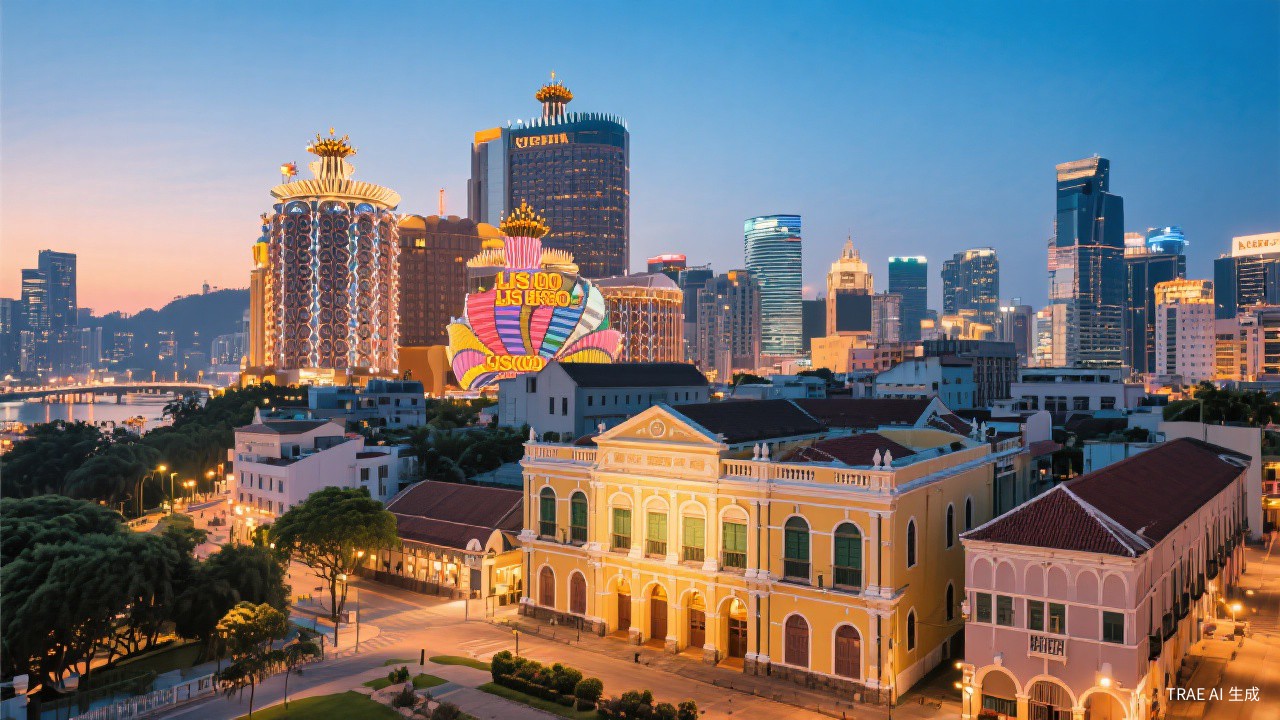
What You Will Find in Macau
Macau is a city of contrasts where Portuguese colonial churches stand next to Las Vegas-style entertainment resorts. The Historic Center, a UNESCO World Heritage Site, contains the ruins of St. Paul's Cathedral (the city's most photographed landmark), the pastel-colored buildings of the Senado Square, and the A-Ma Temple, one of the oldest Taoist temples in the region (built in 1488). Across the water in Cotai, the mega-resorts—Venetian, City of Dreams, Parisian—offer a different kind of spectacle with indoor canals, Eiffel Tower replicas, and 24-hour gaming floors.
Macau's identity straddles two worlds. Portuguese egg tarts are sold alongside dim sum, and street signs appear in both Chinese and Portuguese. The old neighborhoods of Taipa Village, with their cobblestone lanes and pastel houses, have become the city's most charming dining districts. The local Macanese cuisine—a fusion of Portuguese and Chinese cooking—produces dishes like minchi (minced pork with potatoes) and African chicken that exist nowhere else. The city's population of 680,000 is squeezed into just 33 square kilometers, making it one of the most densely populated places on Earth.
Two to three days is sufficient. Spend day one in the Historic Center: Senado Square, St. Paul's Ruins, and the A-Ma Temple. Day two belongs to the Cotai Strip resorts and Taipa Village for dinner. Day three can be a day trip to Coloane, the quieter southern island with Hac Sa Beach and the Lord Stow's Bakery original location.
Best Time to Go
October to December is the most pleasant period, with temperatures between 18 and 25 degrees Celsius and low humidity. The Macau Grand Prix in November fills the city with Formula 3 and touring car races through narrow streets. The Macau International Fireworks Display Contest runs through September and October.
May to September is hot and humid (28 to 35 degrees) with frequent typhoons between July and September. January to March is cool (12 to 20 degrees) and relatively dry, with the Chinese New Year celebrations in January or February bringing dragon dances and temple fairs.
Getting There and Around
Macau has no airport of its own—most visitors fly into Hong Kong International Airport (HKG) and take the ferry or bus across. The Hong Kong-Zhuhai-Macau Bridge bus takes 40 minutes from HKIA to Macau for HKD 65. The Cotai Water Jet and TurboJET ferries run from Hong Kong (1 hour, HKD 170) and Hong Kong Airport (1 hour, HKD 250). Macau is also reachable by land from Zhuhai, China, via the Border Gate.
Macau's free resort shuttle buses cover most major hotels and the ferry terminals. Public buses cost MOP 6 per ride. Taxis start at MOP 19 and are readily available. Walking is feasible in the Historic Center and Taipa Village, but the distances between Cotai resorts require buses or taxis. The Guia Cable Car offers a short but scenic ride up to Guia Fortress.
Where to Stay
The Historic Center has boutique hotels like the Pousada de Sao Tiago (MOP 1,500 to 2,500 per night) and the Hotel Lisboa (MOP 1,000 to 2,000). The area puts you within walking distance of the UNESCO sites. Senado Square and the surrounding streets have several mid-range options in the MOP 600 to 1,000 range.
The Cotai Strip contains the largest resort complexes: The Venetian (MOP 1,800 to 3,500), the Four Seasons (MOP 2,500 to 5,000), and the Parisian (MOP 1,500 to 3,000). These offer enormous rooms, multiple restaurants, and shopping malls. Taipa Village has charming guesthouses like the Casa de Ma (MOP 500 to 900) in a quieter setting.
Must-See Attractions
Ruins of St. Paul's (Ruinas de Sao Paulo)
The stone facade of a 17th-century Catholic church, destroyed by fire in 1835, is Macau's most iconic landmark. The facade features carvings of Jesuit saints, dragons, and a Chinese-style lion. The Museum of Sacred Art and Crypt beneath the ruins displays religious artifacts from the church's active period. The site sits at the top of a grand staircase and is illuminated at night.
Tickets: Free | Open: Daily 8:30 AM-6 PM
Senado Square (Largo do Senado)
The heart of Macau's Historic Center, this wavy-paved square is surrounded by pastel-colored neoclassical buildings, including the Leal Senado (Loyal Senate) and the Holy House of Mercy. The square has been the city's main gathering place since the 16th century. Street performers and food vendors add to the atmosphere. The narrow streets leading from the square are packed with shops selling jerky, almond cookies, and souvenirs.
Tickets: Free | Times: Always open
A-Ma Temple
Built in 1488, this is the oldest temple in Macau and one of the oldest Taoist temples in the region. The temple is dedicated to Mazu, the goddess of seafarers, and contains prayer halls, pavilions, and a granite gate carved with scenes from Chinese mythology. The temple sits on a hillside at the tip of the Macau Peninsula, with views of the harbor.
Admission: Free | Hours: Daily 7 AM-6 PM
The Venetian Macao
The world's largest resort complex by floor area features a replica of Venice's Grand Canal, complete with gondola rides and singing gondoliers. The indoor canal is lined with shops and restaurants under a painted sky ceiling. The gaming floor alone covers 37,000 square meters. Even if you do not game, the scale of the complex is worth seeing.
Admission: Free entry; gondola MOP 168 | Hours: Open 24 hours; shops 10 AM-11 PM
Guia Fortress and Lighthouse
A 17th-century Portuguese fort on the highest point of the Macau Peninsula, containing the oldest lighthouse on the China coast (built 1865) and the Chapel of Our Lady of Guia. The fortress walls offer panoramic views of the city, the bridges to Taipa, and the Pearl River Delta. The Guia Cable Car provides a scenic 80-meter ride to the top.
Entry: Free | Hours: Daily 9 AM-6 PM; cable car 8 AM-6 PM
Food and Drink
Portuguese egg tarts (pastel de nata) — Margaret Cafe e Nata, near Senado Square. MOP 10-15.
African chicken and minchi — A Lorcha, near A-Ma Temple. MOP 150-250.
Dim sum and Cantonese roast goose — Tim Ho Wan, Venetian Cotai. MOP 80-150.
Pork chop bun and almond cookies — Tai Lei Loi Kei, Taipa Village. MOP 30-50.
Practical Tips
• The free resort shuttle buses are the cheapest way to get between the ferry terminal, Historic Center, and Cotai.
• Macau uses the Macanese Pataca (MOP), but Hong Kong Dollars are accepted everywhere at a 1:1 rate.
Bring a light jacket for resorts—the air conditioning is kept extremely cold.
• The Macau Tower bungee jump (233 meters) is the world's highest commercial bungee—book in advance.
• Passports are required for the ferry from Hong Kong—allow extra time for immigration.
Traveler's Tip
Visit the Macau Tower observation deck at sunset (MOP 140). The 223-meter-high deck offers views stretching from the Pearl River Delta to the hills of Zhuhai. If you are feeling adventurous, the Skywalk around the outer rim of the tower (MOP 388) lets you walk hands-free along a narrow ledge with nothing but air below.