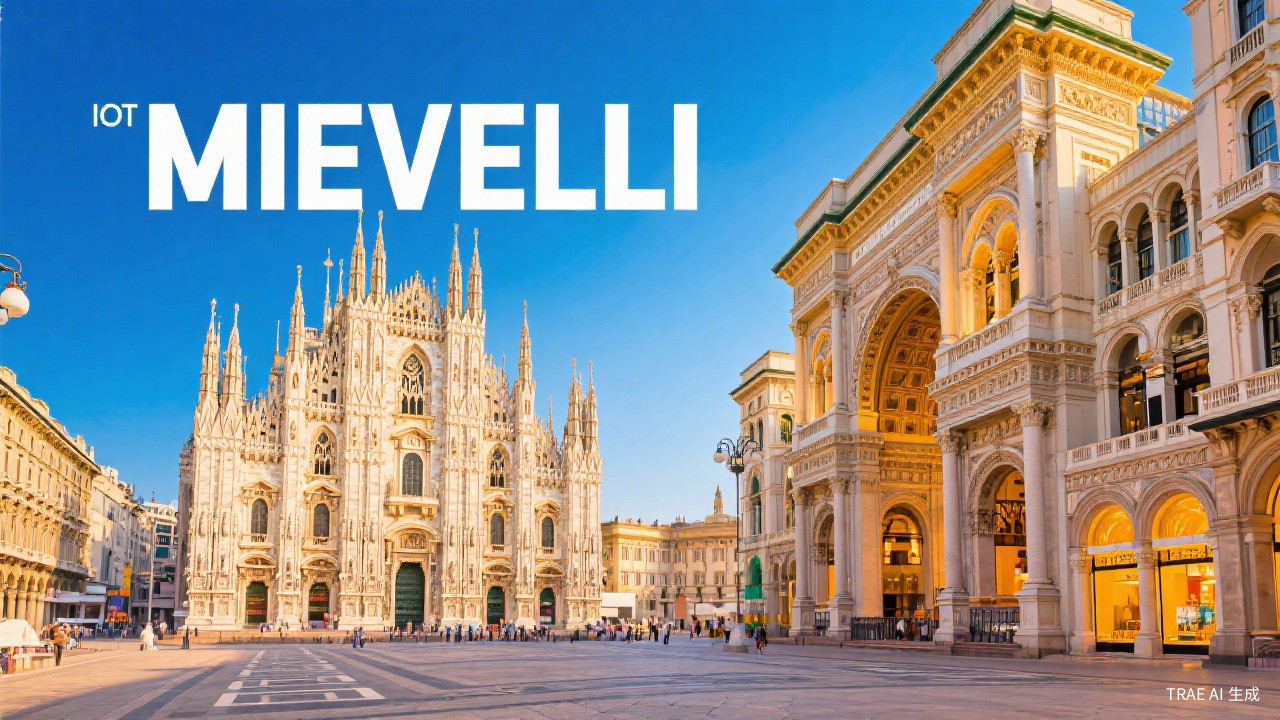
First Impressions of Milan
Milan is Italy's economic engine and its most forward-looking city, where Renaissance masterpieces sit inside glass skyscrapers and fashion boutiques occupy medieval cloisters. Leonardo da Vinci's Last Supper, in the refectory of Santa Maria delle Grazie, is one of the world's most recognized paintings—the 15-year restoration revealed details invisible for centuries. The Duomo di Milano, the third-largest cathedral in the world, took nearly 600 years to complete and has more statues than any other building on earth. The Galleria Vittorio Emanuele II, a 19th-century shopping arcade, connects the Duomo to La Scala opera house under a glass-and-iron ceiling.
Milan's food culture rivals any Italian city. Risotto alla milanese (saffron risotto), cotoletta alla milanese (breaded veal cutlet), and ossobuco (braised veal shank) are the classics. The Navigli district, with its canals designed in part by Leonardo, comes alive at aperitivo hour—the Milanese tradition of a drink accompanied by a buffet of food. Brera, the artistic neighborhood, has galleries, antique shops, and some of the city's best restaurants in a setting that feels more like a village than a metropolis.
Two to three days is sufficient. Day one: the Duomo, Galleria, and La Scala. Day two: the Last Supper, Brera district, and Sforza Castle. Day three: the Navigli canals and shopping in the Quadrilatero della Moda. Milan is flat and very walkable. The metro system is efficient and covers the entire city.
Best Time to Go
April to June and September to October are ideal. Spring temperatures start at 15 to 25 degrees, and the city's parks—Parco Sempione and Giardini di Porta Venezia—are at their best. September brings Milan Fashion Week and the opening of the opera season at La Scala on December 7 (Saint Ambrose's Day).
July and August are hot (28 to 35 degrees) and humid—many locals leave for the coast. Restaurants and shops may close for August holidays. Winter (December to February) is cold (0 to 8 degrees) but atmospheric, with the Oh Bej! Oh Bej! street fair in December and the opera season in full swing.
Getting There and Around
Milan has three airports: Malpensa (MXP), 50 kilometers northwest, is the main international hub. The Malpensa Express train connects to Cadorna station in 52 minutes for €13. Linate (LIN), 8 kilometers east, handles domestic and European flights—the 73X bus connects to San Babila for €1.50. Bergamo Orio al Serio (BGY), 50 kilometers east, is used by budget airlines.
Milan's metro has four lines (M1 red, M2 green, M3 yellow, M5 lilac). A single ticket is €2.20, and a day pass is €7.60. The metro runs from 6 AM to midnight. Trams and buses supplement the network. Milan is very walkable—the center is flat and compact. The bike-sharing system (BikeMi) has stations throughout the city.
Where to Stay
The area around the Duomo and Galleria is the most convenient. Hotels start at €120 to €400 per night. You are steps from the main sights and the Quadrilatero della Moda shopping district. The area is busy but well-connected.
Brera, north of the Duomo, is the most charming neighborhood. Hotels and boutique guesthouses start at €90 to €250 per night. The area has narrow cobblestone streets, art galleries, and excellent restaurants. It feels intimate despite being in the city center.
The Navigli district, south of the center, is Milan's nightlife and aperitivo hub. Hotels start at €70 to €180 per night. The canals come alive in the evening with outdoor bars and restaurants. It is a 15-minute walk or a short metro ride to the center. Porta Romana, on the southeast edge, offers good value with rooms from €60 to €150 per night.
Must-See Attractions
The Last Supper by Leonardo da Vinci
Painted between 1495 and 1498 on the refectory wall of Santa Maria delle Grazie, this fresco depicts the moment Christ announces that one of his disciples will betray him. The 15-year restoration completed in 1999 revealed original colors and details. Tickets must be booked months in advance online. Visits are limited to 15 minutes in small groups.
Tickets: €15 | Hours: 8:15 AM to 7 PM, Tuesday to Sunday
Duomo di Milano
The third-largest cathedral in the world, begun in 1386 and completed in 1965. The exterior is covered in 3,400 statues, 135 gargoyles, and 700 figures. The rooftop terraces offer views over the city and, on clear days, to the Alps. Take the elevator (or climb 250 steps) to reach the terraces. The interior contains stained glass windows and the tomb of Saint Charles Borromeo.
Tickets: Cathedral free; rooftop €14 (stairs) or €18 (elevator) | Open: 8 AM to 7 PM; rooftop 9 AM to 7 PM
Galleria Vittorio Emanuele II
A 19th-century shopping arcade connecting Piazza del Duomo to Piazza della Scala. The glass-and-iron dome, mosaic floors, and ornate stucco make it one of the world's most beautiful shopping spaces. Prada, Gucci, and Louis Vuitton have stores here. The mosaic bull on the floor—tradition says spinning on its heel brings luck—is worn smooth by generations of visitors.
Cost: Free | Open: 7 AM to 10 PM daily
Pinacoteca di Brera
Milan's finest art gallery, housed in a 17th-century palazzo. The collection focuses on Italian Renaissance painting: Raphael's Marriage of the Virgin, Caravaggio's Supper at Emmaus, and Mantegna's Dead Christ. The room of Venetian paintings, with works by Bellini and Veronese, is exceptional. Allow two hours.
Tickets: €15 | Times: 8:30 AM to 7:15 PM, Tuesday to Sunday
Sforza Castle and Parco Sempione
A massive red-brick castle built by the Sforza dynasty in the 15th century, now housing several museums including the Museum of Ancient Art, the Furniture Museum, and Michelangelo's unfinished Rondanini Pieta. The castle opens onto Parco Sempione, a large park designed in the English style. The Arco della Pace (Arch of Peace) at the park's far end is a good photo spot.
Admission: Museums €5 each; castle courtyards free | Open: 7 AM to 7 PM; museums 9 AM to 5:30 PM
Food and Drink
Risotto alla Milanese — Saffron-infused risotto, golden yellow and creamy, often served with ossobuco (braised veal shank). Trattoria Milanese, open since 1933 near the Duomo, serves one of the city's best versions. The saffron gives the rice a distinctive flavor and color.
Cotoletta alla Milanese — A breaded veal cutlet fried in butter, traditionally served with a lemon wedge. The cutlet should be thin and crispy. Ristorante Trussardi alla Scala, near La Scala opera house, offers an upscale version. For a more casual experience, try Al Vecchio Drago in the Navigli district.
Panettone — Milan's Christmas bread, a tall dome-shaped sweet bread with candied fruit and raisins. Available from November to January. Pasticceria Cova, founded in 1817, makes one of the finest versions. Buy a whole panettone to take home—they keep for weeks.
Aperitivo at Navigli — The Milanese tradition of a pre-dinner drink (usually an Aperol Spritz or Negroni) accompanied by a buffet. Many bars in the Navigli district offer aperitivo for €8 to €12, including unlimited food. Rita & Cocktails and Mag Cafe are among the best. Arrive by 7 PM for the best food selection.
Practical Tips
Book the Last Supper tickets online at least two months in advance. Same-day tickets are almost never available.
• The metro is the fastest way to get around. Avoid driving in the center—traffic is heavy and parking expensive.
• Milan is a fashion city. Dress well if you want to enter upscale restaurants or shops.
• Many restaurants close between lunch and dinner (2:30 PM to 7:30 PM). Plan meals accordingly.
• The aperitivo tradition (6 PM to 9 PM) is the best value meal in Milan. One drink gets you access to a full buffet.
Traveler's Tip
Visit the Brera district on a Saturday morning. The Pinacoteca opens at 8:30 AM and is nearly empty. Afterward, browse the antique shops on Via Fiori Chiari, then have lunch at I Ragazzi della Brera, a tiny restaurant with only six tables that serves some of the best pasta in Milan.