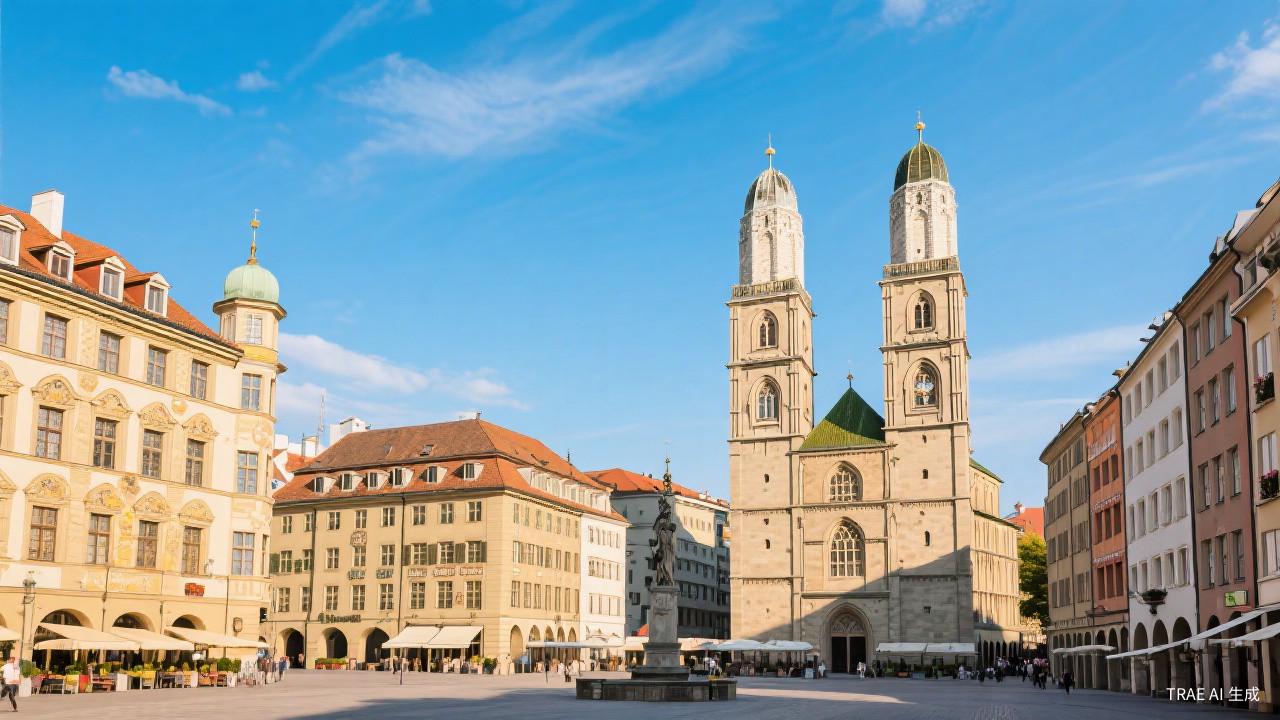
What You Will Find in Munich
Munich is Germany's most livable city—wealthy, clean, and culturally rich, with the Alps visible on clear days from the city center. The Marienplatz, with its neo-Gothic Neues Rathaus (New Town Hall) and the Glockenspiel, is the heart of the city. The Englischer Garten, larger than Central Park, has a river where surfers ride a standing wave. The Pinakothek museums hold some of Europe's finest art collections, from Old Masters at the Alte Pinakothek to contemporary works at the Pinakothek der Moderne. The Nymphenburg Palace, the summer residence of the Bavarian Wittelsbach dynasty, has baroque gardens stretching for kilometers.
Bavarian identity is strong in Munich. Dirndls and lederhosen appear not just at Oktoberfest but at beer gardens, markets, and Sunday services. The Viktualienmarkt, a daily food market since 1807, sells Weisswurst, pretzels, and mountain cheese under colorful umbrellas. The beer garden culture—originally as a place to drink beer brewed by monks—is a daily ritual. The Augustiner-Keller, one of the oldest beer gardens, seats 5,000 people under chestnut trees.
Three to four days is ideal. Day one: Marienplatz, Viktualienmarkt, and the Englischer Garten. Day two: the Pinakothek museums and Konigsplatz. Day three: Nymphenburg Palace and the BMW Museum. Day four: a day trip to Neuschwanstein or the Alps. The Munich City Pass covers public transport and museum entries.
Best Time to Go
June through September offers warm weather (18 to 28 degrees) and long days. The Tollwood Festival in summer brings music, theater, and food to the Olympiapark. Oktoberfest runs from mid-September to the first weekend of October—book accommodation six months ahead.
December is magical for the Christkindlmarkt on Marienplatz, with gluhwein, gingerbread, and a 30-meter Christmas tree. Winter temperatures drop to -5 to 5 degrees, but the beer gardens have indoor areas. Spring (April to May) brings beer garden season and the Fruhlingsfest (spring festival) at Theresienwiese.
Getting There and Around
Munich Airport (MUC) is 28 kilometers northeast. The S-Bahn S1 and S8 connect to Hauptbahnhof in about 40 minutes for €9.60. The Lufthansa Express Bus runs every 20 minutes for €10.50. Taxis cost €55 to €70.
The MVV network (U-Bahn, S-Bahn, trams, buses) covers the entire city. A single ticket is €2.90, a day pass is €8.80, and the Munich City Pass (from €14.90) includes transport and museum entries. The U-Bahn is the fastest way to get around. Bicycles are widely available for rent.
Where to Stay
The Altstadt (Old Town) around Marienplatz is the most convenient base. Hotels start at €100 to €300 per night. Stay near Viktualienmarkt for food market access. The area is walkable and well-connected.
Schwabing, north of the center, is Munich's bohemian neighborhood. Hotels start at €80 to €200 per night. The area has the Englischer Garten, university life, and excellent cafes. Leopoldstrasse is the main drag.
Glockenbachviertel, south of the center, is trendy and gay-friendly. Hotels start at €70 to €180 per night. The area has vintage shops, small galleries, and some of Munich's best restaurants. Maxvorstadt, near the Pinakothek museums, is another good option with rooms from €60 to €150 per night.
Must-See Attractions
Marienplatz and Glockenspiel
Munich's central square since 1158. The Neues Rathaus dominates the north side with its 85-meter tower. The Glockenspiel chimes at 11 AM and 5 PM (noon in summer), with 32 figures reenacting the marriage of Duke Wilhelm V and the Schafflertanz (coopers' dance). The Viktualienmarkt food market is one block south.
Admission: Free | Open: Square always open; market Monday to Saturday 10 AM to 6 PM
Englischer Garten
At 375 hectares, this is one of the world's largest urban parks. The Chinese Tower beer garden seats 7,000 under chestnut trees. The Eisbachwelle, a standing river wave near the southern entrance, is surfed year-round. The Monopteros, a Greek-style temple on a hill, offers views over the park and city skyline.
Admission: Free | Open: Always open
Nymphenburg Palace
The summer residence of the Bavarian Wittelsbach dynasty, built in the late 17th century. The baroque palace contains the Stone Hall, a gallery of portraits of beauties painted for King Ludwig I, and the Gallery of Beauties. The park stretches for two kilometers and contains several pavilions including the Amalienburg hunting lodge with its Hall of Mirrors.
Cost: €15 | Hours: 9 AM to 6 PM, April to October; 10 AM to 4 PM, November to March
Alte Pinakothek
One of Europe's finest Old Master collections, housed in a neoclassical building. Works include Durer's Self-Portrait, Rubens's Large Last Judgment, and Albrecht Altdorfer's Battle of Alexander at Issus. The collection spans the 14th to 18th centuries with particular strength in German, Flemish, and Italian painting.
Cost: €10 | Times: 10 AM to 6 PM, Tuesday to Sunday
BMW Museum and BMW Welt
The BMW Welt (World) is a free exhibition space showcasing the latest models and concept cars in a dramatic building designed by Coop Himmelb(l)au. The adjacent BMW Museum traces the company's history from aircraft engines to motorcycles to cars. The building's spiral interior is itself a work of architecture.
Cost: BMW Welt free; BMW Museum €10 | Open: BMW Welt 9 AM to 6 PM; Museum 10 AM to 6 PM
Food and Drink
Weisswurst Breakfast at Augustiner-Keller — Munich's signature morning: veal and pork sausages simmered in water, eaten without the skin with sweet mustard and a pretzel. Tradition says the sausages must be consumed before noon. The Augustiner-Keller beer garden serves them from 9 AM with a liter of helles beer.
Schweinshaxe at Augustiner am Dom — A roasted pork knuckle with crackling skin, served with potato dumplings and red cabbage. The crispy exterior and tender interior make it one of Bavaria's most satisfying dishes. Augustiner am Dom, near the Frauenkirche, serves one of the best versions in Munich.
Obatzda at Chinesischer Turm — A Bavarian cheese spread made from camembert, butter, paprika, and onions, served with pretzels and radishes. The Chinesischer Turm beer garden in the Englischer Garten serves an excellent version. It is the perfect snack with a beer on a warm afternoon.
Apple Strudel at Cafe Luitpold — A traditional Viennese-style apple strudel with raisins, cinnamon, and a flaky crust, served warm with vanilla sauce. Cafe Luitpold, open since 1888, is one of Munich's most elegant coffee houses. The interior has marble columns and stucco ceilings.
Practical Tips
• The Munich City Pass includes public transport and museum entries. Calculate whether it suits your plans.
• Oktoberfest is extremely crowded and expensive. Book accommodation six months ahead.
• Beer gardens allow you to bring your own food. Buy bread and cheese from a supermarket.
• Cash is preferred in Bavaria. Many smaller establishments do not accept cards.
• Sunday is a rest day in Germany—shops are closed, but restaurants, beer gardens, and museums are open.
Traveler's Tip
Visit the Chinesischer Turm beer garden in the Englischer Garten on a Sunday afternoon. A brass band plays from the tower, families gather at long wooden tables, and children ride the carousel. Order a Mass of Augustiner helles and a pretzel, and stay for three hours. It is the most Bavarian experience you can have without leaving Munich.