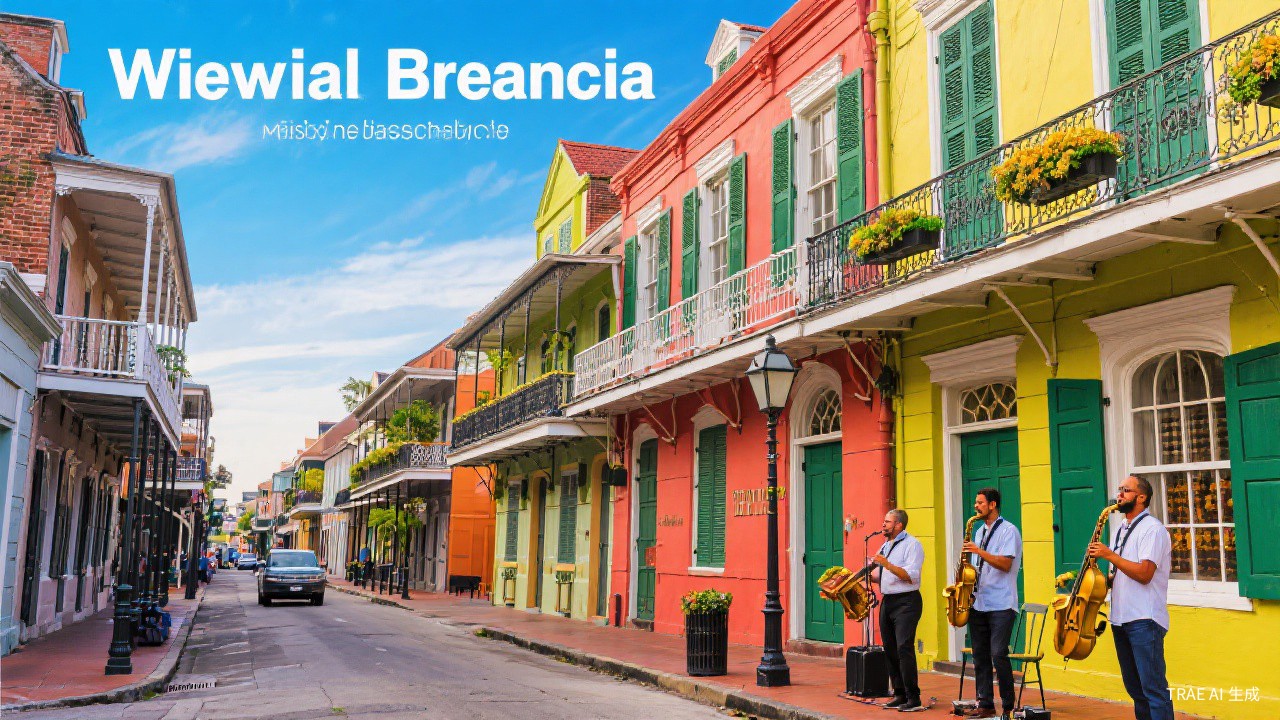
Discovering New Orleans
New Orleans is the most culturally distinct city in the United States. Founded by the French in 1718, ruled by Spain for 40 years, and purchased by the United States in 1803, the city absorbed influences from each culture plus those of enslaved Africans, Caribbean immigrants, and Native Americans. The result is a place that sounds, tastes, and feels different from anywhere else in America.
The French Quarter, the oldest neighborhood, is where the city's identity is most concentrated. Jackson Square, with its cast-iron fence and St. Louis Cathedral, faces the Mississippi River. Bourbon Street, one block away, is the city's most famous thoroughfare, with bars and music clubs open 24 hours. But the French Quarter's real character is in its quieter streets—Royal Street with its antique shops and galleries, the residential blocks with their wrought-iron balconies and hidden courtyards.
New Orleans is also the birthplace of jazz. Brass bands play in the streets, and venues like Preservation Hall and the Spotted Cat Music Club offer live jazz nightly. The city's food—gumbo, jambalaya, po'boys, muffulettas, beignets, and crawfish etouffee—is one of the great regional cuisines in America. The Garden District, with its antebellum mansions and oak-lined streets, offers a contrast to the French Quarter's density.
Best Time to Go
February to May is the best time to visit. Weather is mild (15-25°C), and the city's festival calendar is packed. Mardi Gras (date varies, February or March) is the biggest event, drawing over a million visitors. The French Quarter Festival in April and the New Orleans Jazz and Heritage Festival (Jazz Fest) in late April/early May are also major draws.
Winter (December to January) is cool (8-18°C) and the least crowded time outside Mardi Gras. Christmas in New Orleans is festive, with caroling in Jackson Square and Reveillon dinners at restaurants throughout the city.
Summer (June to September) is hot (28-35°C) and extremely humid. Afternoon thunderstorms are daily. This is hurricane season. Hotel rates are the lowest of the year.
Getting There and Around
Louis Armstrong New Orleans International Airport (MSY) is 15 miles west of downtown, with direct flights from most major US cities. From the East Coast, flights take 2-3 hours; from the West Coast, 4 hours.
Taxis from the airport to the French Quarter cost a flat rate of $36 for up to two passengers. Uber and Lyft are also available and sometimes cheaper.
The streetcar system is iconic and practical. The St. Charles Avenue line ($1.25 per ride) passes through the Garden District and the Warehouse District. Walking is the best way to explore the French Quarter, the Marigny, and the Warehouse District. These neighborhoods are compact and connected by short distances.
Where to Stay
The French Quarter is the most convenient area, with hotels ranging from $100-400 per night. The quieter streets (Royal, Chartres, Burgundy) are preferable to Bourbon Street for sleeping.
The Marigny (Faubourg Marigny), just east of the French Quarter, has a more local feel with B&Bs and small hotels ($80-200 per night). Frenchmen Street, the Marigny’s main drag, has the best live music venues in the city.
The Warehouse District, between the French Quarter and the Garden District, has boutique hotels ($120-300 per night) and is within walking distance of the National WWII Museum.
Must-See Attractions
French Quarter and Jackson Square
The French Quarter is the oldest section of New Orleans, with buildings dating to the 18th century. Jackson Square, the central plaza, is framed by the St. Louis Cathedral (the oldest continuously operating cathedral in the US), the Cabildo, and the Presbytere. Street performers, artists, and fortune tellers work the square daily. The surrounding streets contain restaurants, bars, galleries, and historic buildings. Allow a full day to explore.
Entry: Free to explore | Open: Always open
Garden District
This residential neighborhood contains some of the finest antebellum architecture in the South. St. Charles Avenue is lined with oak trees and grand mansions. The self-guided walking tour passes homes of writers, politicians, and celebrities. Lafayette Cemetery No. 1, with its above-ground tombs, is a short walk away. The St. Charles streetcar provides access from downtown.
Entry: Free (streetcar $1.25) | Times: Best during daylight hours
Swamp Tours
Airboat or flatboat tours through the bayous and swamps south of New Orleans offer close encounters with alligators, turtles, egrets, and herons. Tours depart from points 30-45 minutes from the city. Airboat tours ($50-70) are faster and louder; flatboat tours ($25-45) are quieter and better for photography. Most tours last 2 hours.
Cost: $25-70 depending on tour type | Open: Multiple departures daily, 9 AM-4 PM
National WWII Museum
This museum, located in the Warehouse District, is widely regarded as the best WWII museum in the United States. Exhibits cover all theaters of the war with artifacts, oral histories, and immersive displays. The Tom Hanks-narrated Beyond All Boundaries film is a powerful 4-D experience. Allow 4-5 hours.
Cost: $28 adult | Times: 9 AM-5 PM daily
Preservation Hall
This intimate venue in the French Quarter has been presenting traditional New Orleans jazz since 1961. The building is simple—a bare room with benches—but the music is extraordinary. Sets last 45-60 minutes, with no amplification. General admission ($20-30) is first-come, first-served—arrive 30-45 minutes early.
Cost: $20-60 | Open: Shows at 5, 6, 7:30, 8:30, 9:30 PM nightly
Food and Drink
Po’boy — A French bread sandwich stuffed with fried shrimp, oysters, roast beef, or sausage, dressed with lettuce, tomato, pickles, and mayonnaise. Parkway Bakery and Domilise’s are the two most famous po’boy shops. A half po’boy costs $8-12, a full $12-18.
Gumbo — A roux-based soup thickened with okra or filé powder, containing seafood, chicken, and/or andouille sausage. The version at Dooky Chase’s Restaurant, a historic Creole restaurant, is legendary. A bowl costs $12-18.
Beignets and Cafe au Lait — Square-shaped fried dough covered in powdered sugar, served with coffee mixed with chicory. Café du Monde in the French Quarter has been serving them since 1862 and is open 24 hours. An order of three beignets and a café au lait costs about $7. Cash only.
Muffuletta — A round sesame bread loaf split and filled with salami, ham, provolone, olive salad, and mortadella. Central Grocery, in the French Quarter, invented the sandwich in 1906. A whole muffuletta feeds 2-3 people and costs $18-22.
Practical Tips
• Stay on or near Frenchmen Street rather than Bourbon Street for music. The venues are better and the experience is more authentic.
• Carry cash. Many small restaurants, bars, and street vendors in the French Quarter do not accept credit cards.
• Drink responsibly and stay in groups at night. The French Quarter is generally safe but can be unpredictable late at night.
• Make restaurant reservations in advance for dinner. Popular spots book out weeks ahead.
• Be prepared for heat and humidity in summer. Air conditioning is everywhere indoors, but walking between venues in July or August is physically demanding.
Traveler's Tip
Get up early on a weekday and walk the French Quarter before 8 AM. The streets are empty, the light is soft, and the architecture—the wrought-iron balconies, the brick facades, the courtyards visible through open gates—is at its most visible without the crowds.