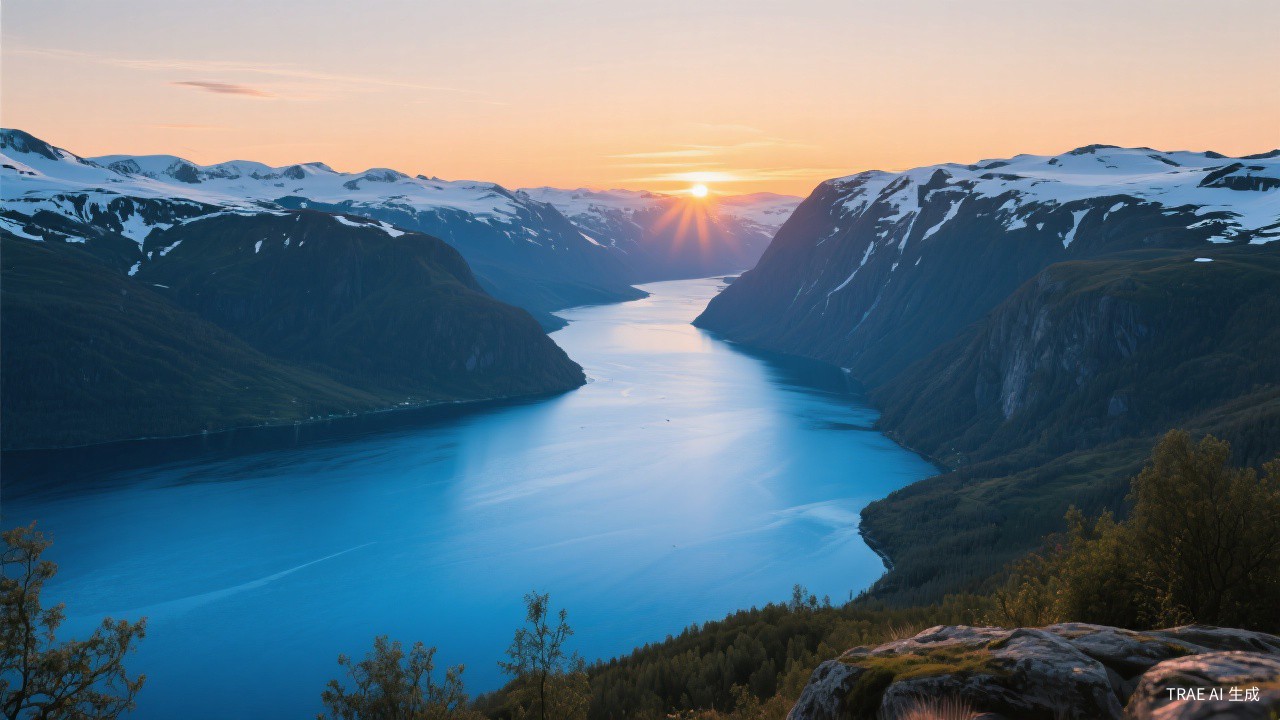
What You Will Find in Norway
Norway's fjords are among the most dramatic terrain on earth—steep cliffs rising from dark water, waterfalls cascading down moss-covered rock faces, and villages tucked into narrow inlets. Geirangerfjord and Naeroyfjord, both UNESCO World Heritage Sites, are the most famous, but the Sognefjord (the longest at 204 kilometers) and the Trollfjord (the narrowest) are equally impressive. The Lofoten Islands, above the Arctic Circle, offer fishing villages with red wooden cabins (rorbuer) set against jagged granite peaks. In winter, the Northern Lights dance across the sky; in summer, the sun never sets.
Norway stands out as prosperous and well-organized countries in the world, and traveling here is efficient but expensive. The Norwegian concept of friluftsliv (open-air living) means that locals spend as much time as possible outdoors—hiking, skiing, kayaking, and foraging for berries and mushrooms. The food culture has undergone a revolution in the past decade, with restaurants like Maaemo in Oslo and Restaurant Under in Lindesnes earning international recognition. Traditional dishes like rakfisk (fermented trout), klippfisk (dried cod), and brunost (brown cheese) remain popular.
Allow at least 10 days to see both fjords and cities. A classic route: Oslo to Bergen by train (seven hours on the Bergen Railway), Bergen to Geiranger by ferry, the Geiranger to Flam road, the Flam Railway, and a flight or ferry to the Lofoten Islands. The Norway in a Nutshell package combines trains, boats, and buses for a complete fjord experience.
Best Time to Go
June to August offers midnight sun above the Arctic Circle and long days in the south. Temperatures start at 15 to 25 degrees in the south, 10 to 18 degrees in the north. This is the best time for hiking, fjord cruises, and the North Cape. The Bergen International Festival runs in May and June.
September to March is Northern Lights season. The lights are visible from October to March, with the darkest skies in December and January. Tromso is the most popular base for aurora viewing. Winter temperatures start at -5 to 5 degrees in the south, -10 to -20 degrees in the north. Spring (April to May) brings melting snow, waterfalls at their fullest, and fewer tourists.
Getting There and Around
Oslo Airport (OSL) is the main international gateway, 47 kilometers northeast of the city. The Flytoget train connects to Oslo Central Station in 20 minutes for 197 NOK (€18). Bergen Airport (BGO) has domestic and European connections. Tromso Airport (TOS) serves the north. Wideroe and Norwegian operate domestic flights.
Norway's rail network is scenic and efficient. The Bergen Railway from Oslo to Bergen (seven hours, from 499 NOK) crosses the Hardangervidda plateau. The Flam Railway (one hour, 440 NOK) descends from Myrdal to Flam through 20 tunnels. The Hurtigruten coastal ferry runs from Bergen to Kirkenes (12 days, from 3,500 NOK per person in a cabin). Car rental costs from 500 NOK per day.
Where to Stay
Oslo's city center around Karl Johans Gate is the most convenient base. Hotels start at 1,000 to 3,000 NOK (€90 to €270) per night. The Aker Brygge waterfront area has restaurants and the Astrup Fearnley Museum. Gronland, east of the center, is more affordable with rooms from 700 NOK (€65) per night.
Bergen's Bryggen (wharf) area is a UNESCO World Heritage Site with colorful wooden buildings. Hotels start at 1,000 to 2,500 NOK (€90 to €225) per night. The area is atmospheric but touristy. Sandviken, north of the center, is quieter with guesthouses from 600 NOK (€55) per night.
In the Lofoten Islands, rorbuer (fishermen's cabins) are the traditional accommodation. They start at 800 to 2,000 NOK (€70 to €180) per night and come with kitchens and water views. Reine, Hamnoy, and Svolvaer are the most popular bases. Hotels in Tromso start at 1,000 to 2,500 NOK (€90 to €225) per night.
Must-See Attractions
Geirangerfjord Cruise
A two-hour ferry ride through one of Norway's most spectacular fjords. The boat passes the Seven Sisters waterfall (seven streams cascading 300 meters), the Suitor waterfall opposite, and the abandoned farm of Skagefla perched on a cliff. The fjord is 15 kilometers long and up to 260 meters deep. The views from the ferry deck are extraordinary in any weather.
Admission: From 320 NOK (€29) | Hours: Ferries run May to September, multiple departures
Trolltunga (Troll's Tongue)
A rock formation jutting 700 meters above Ringedalsvatnet lake, reached by a 10 to 12-hour hike (27 kilometers round trip) from Skjeggedal. The hike is demanding but the reward—standing on the tongue with the lake far below—is one of Norway's most iconic experiences. The hike is accessible from June to September. Guided tours are available.
Admission: Free; guided tours from 1,500 NOK (€135) | Times: June to September only
Preikestolen (Pulpit Rock)
A flat rock plateau 604 meters above the Lysefjord, reached by a two-hour hike from the Preikestolen mountain lodge. The hike is moderate—well-marked and manageable for most fitness levels. The view from the edge, looking straight down into the fjord, is dizzying. The rock is 25 by 25 meters—large enough to feel safe, but the drop is vertical.
Tickets: Free | Hours: Year-round; best April to October
Northern Lights in Tromso
Tromso, 350 kilometers above the Arctic Circle, is one of the best places to see the aurora borealis. The lights appear from September to March on clear nights. Guided tours take visitors away from city lights to maximize viewing chances. The Aurora Forecast app helps predict activity. A typical tour costs 1,200 to 1,800 NOK (€110 to €165) and includes transport and warm suits.
Admission: Tours from 1,200 NOK (€110) | Times: Night tours, September to March
Bryggen Wharf, Bergen
A UNESCO World Heritage Site of 62 wooden buildings dating to the Hanseatic League era (14th to 17th centuries). The narrow alleyways between the colorful facades contain shops, restaurants, and the Hanseatic Museum, which preserves a merchant's office from the 1700s. The Bryggen area is Bergen's most photographed spot and the social heart of the city.
Tickets: Free to explore; Hanseatic Museum 120 NOK (€11) | Open: Always open; museum 10 AM to 5 PM
Food and Drink
Salmon at Mathallen Oslo — Norwegian salmon is among the best in the world—cold, clear rivers produce fish with firm flesh and rich flavor. Mathallen, Oslo's food hall, has several stalls serving smoked, cured, and fresh salmon. The salmon sashimi at Restaurant Sabi Sushi is excellent.
Brunost on Waffles — Brown cheese, made from whey and goat's milk, has a caramel-like sweetness. It is traditionally eaten on vafler (Norwegian waffles) with sour cream and jam. Try it at any cafe in Bergen—the waffle at Kaffemisjonen near Bryggen is excellent.
Reindeer Stew in Tromso — Sautéed reindeer meat with lingonberries and root vegetables, served with mashed potatoes. It is a Sami specialty and widely available in northern Norway. Try it at Emma's Dream Kitchen in Tromso, a small restaurant run by a Sami family.
Lutefisk — Dried cod reconstituted in lye, then baked or boiled and served with bacon, peas, and potatoes. It is a traditional Christmas dish and an acquired taste—the texture is gelatinous and the flavor is mild. Try it at Restaurant Schrøder in Oslo, which has been serving traditional Norwegian food since 1956.
Practical Tips
• Norway is extremely expensive. Budget at least 1,000 to 1,500 NOK (€90 to €135) per day per person for food and transport.
• The Norway in a Nutshell pass combines trains, ferries, and buses. It is convenient but not always cheaper than booking individually.
• Grocery stores (Rema 1000, Kiwi) are the cheapest way to eat. Pick up supplies for picnics and trail snacks.
Book accommodation well in advance for summer and Northern Lights season. Popular places fill up months ahead.
• Download the Norway apps: Ruter (Oslo transit), Entur (national transit), and Aurora Forecast (Northern Lights).
Traveler's Tip
Take the Flam Railway from Myrdal to Flam, then the ferry from Flam to Gudvangen through the Naeroyfjord. The train descent through 20 tunnels and past waterfalls is spectacular, and the ferry through the narrowest fjord in the world is even better. Book the combination ticket in advance for the best price.