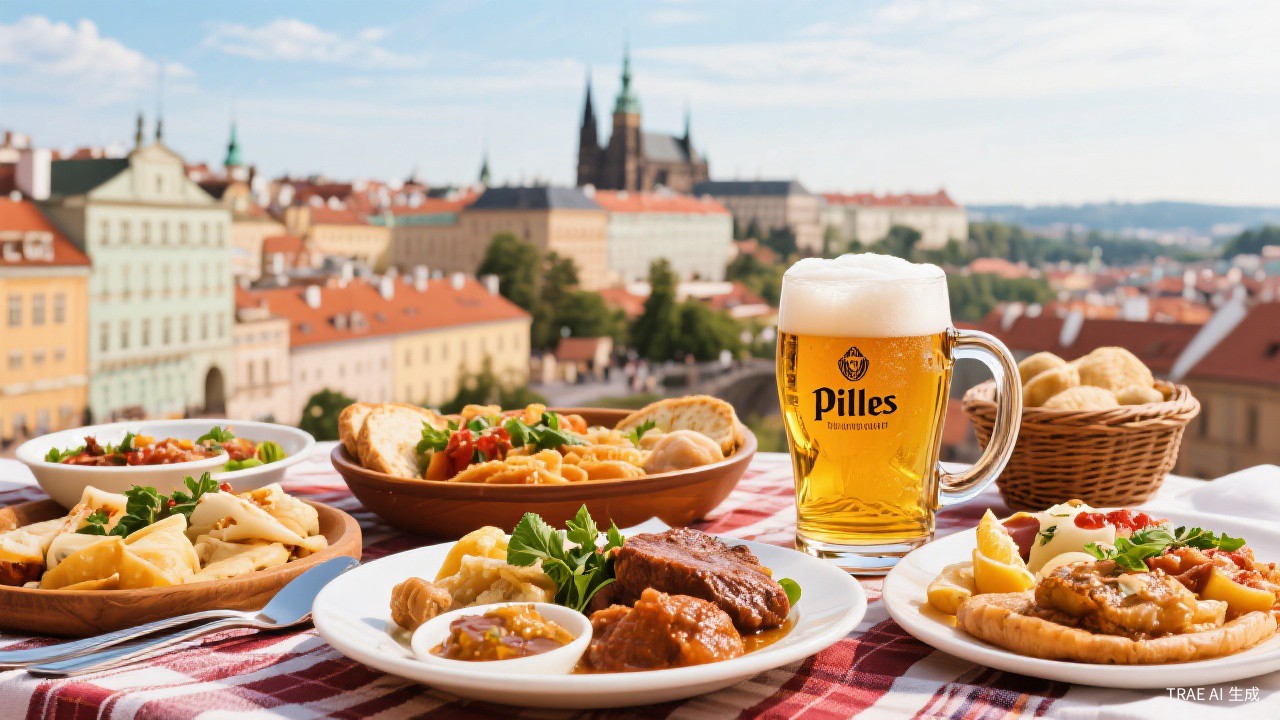
What You Will Find in Prague Food
Prague's food scene is built on hearty Czech traditions: roast pork with dumplings and cabbage, svickova (marinated beef with creamy sauce), and goulash served in bread bowls. The city's beer culture is arguably the best in the world—the Czech Republic has the highest per-capita beer consumption globally, and Prague is home to dozens of brewpubs serving fresh pilsner and dark lager for under €2 a pint. The Old Town's medieval streets hide traditional taverns (hospodas) that have been serving the same recipes for centuries.
Eating in Prague is also about the setting. The city's Gothic, Baroque, and Art Nouveau architecture provides a backdrop for every meal. The Wenceslas Square area has grand cafes like Cafe Louvre (open since 1902), while the Lesser Town has small wine bars in Renaissance buildings. The Havelska Market, a daily farmers market in the Old Town, sells sausages, trdelnik (chimney cake), and fresh produce. The food scene has also modernized—new restaurants like La Degustation Boheme Bourgeoise have earned Michelin stars.
Two to three days is enough for a food-focused trip. Spend day one in the Old Town and Wenceslas Square, day two in the Lesser Town and Prague Castle area, and day three exploring Vinohrady and Zizkov for local beer halls. Prague is very walkable, and the metro connects all neighborhoods.
Best Time to Go
April to June and September to October are ideal. Spring temperatures start at 10 to 22 degrees, and the beer gardens open. September brings the Czech Beer Festival in Prague, drawing brewers from across the country. These months have pleasant outdoor dining weather and fewer tourists than summer.
December is magical—the Christmas markets on Old Town Square sell medovina (honey wine), trdelnik, and roasted ham. Winter temperatures drop to -5 to 5 degrees, but the hospodas are warm. July and August are warm (20 to 30 degrees) but crowded. The Prague Food Festival in May is a major event.
Getting There and Around
Vaclav Havel Airport (PRG) is 15 kilometers west of the center. The Airport Express bus runs to Hlavni Nadrazi (main station) in 35 minutes for 60 CZK (€2.40). Taxis cost about 500 CZK (€20). The 119 bus connects to Dejvicka metro station for 32 CZK (€1.30).
Prague's metro has three lines (A green, B yellow, C red). A single ticket is 32 CZK (€1.30), and a 24-hour pass is 120 CZK (€4.80). Trams supplement the metro—tram 22 follows a scenic route through the Lesser Town and up to Prague Castle. Prague is very walkable, but the hills can be steep.
Where to Stay
The Old Town (Stare Mesto) is the most convenient base. Hotels start at €60 to €200 per night. You are within walking distance of the main sights, beer halls, and restaurants. The area around Old Town Square is the most central.
The Lesser Town (Mala Strana) is quieter and more atmospheric, with hotels from €70 to €250 per night. The cobblestone streets and Baroque architecture give it a village feel. It is a 10-minute walk across Charles Bridge to the Old Town.
Vinohrady and Zizkov, east of the center, are residential neighborhoods with excellent beer halls and restaurants. Hotels start at €40 to €120 per night. Zizkov is famous for its pub culture—the area has the highest concentration of bars per capita in Prague. Vinohrady is slightly more upscale with Art Nouveau architecture.
Must-See Attractions
Old Town Square and Astronomical Clock
The 600-year-old astronomical clock on the Old Town Hall chimes every hour, with apostle figures appearing in windows above the clock face. The square itself is surrounded by Gothic and Baroque buildings and is the site of the Christmas market in winter. The Church of Our Lady before Tyn, with its distinctive spires, dominates the north side.
Admission: Free | Times: Square always open; clock tower 200 CZK (€8)
Havelska Market
A daily farmers market in a pedestrian street between Wenceslas Square and Old Town Square. Vendors sell fresh fruit, vegetables, sausages, cheese, and baked goods. It is a good place to try trdelnik (chimney cake) and medovina (honey wine). The market has been operating in some form since the 13th century.
Admission: Free to browse | Times: 7 AM to 6 PM Monday to Saturday
Prague Castle and Lesser Town
The largest ancient castle complex in the world, overlooking the Vltava River. The castle grounds contain St. Vitus Cathedral, the Old Royal Palace, and the Golden Lane (a street of tiny colorful houses). The Lesser Town below has restaurants and cafes in Baroque buildings. The walk from the castle down through the Lesser Town to Charles Bridge is one of Europe's finest urban walks.
Entry: Castle circuit 250 CZK (€10) | Hours: 6 AM to 10 PM; circuit 9 AM to 4 PM
Letna Beer Garden
Prague's most popular beer garden, set on a hilltop in Letna Park with panoramic views over the city's bridges and spires. The garden has long wooden tables, cheap beer (around 45 CZK or €1.80 per half-liter), and a relaxed atmosphere. Locals come here after work and on weekends. The walk up from the Lesser Town takes about 15 minutes.
Tickets: Beer from 45 CZK (€1.80) | Open: 10 AM to 10 PM, April to October
Zizkov Television Tower
A 216-meter tower built in 1987, visible from across Prague. The observation deck at 93 meters offers 360-degree views. The tower is decorated with crawling baby sculptures by David Cerny. The basement contains a contemporary art gallery. The surrounding park is a good spot for views of the tower itself.
Entry: 250 CZK (€10) | Open: 10 AM to midnight
Food and Drink
Svickova at Lokal — Marinated beef sirloin with creamy root vegetable sauce, served with bread dumplings and cranberry compote. Lokal, a chain of traditional Czech restaurants, serves one of the best and most authentic versions in Prague. The portions are generous and the prices are fair.
Pilsner Urquell at U Zlateho Tygra — The most famous Czech beer, served fresh from the tank at this legendary pub near Old Town Square. The bar has been open since 2004 but feels like it has been there for centuries. A half-liter costs about 50 CZK (€2). The pub is small and often standing-room only.
Trdelnik (Chimney Cake) — A sweet pastry made by wrapping dough around a cylinder, roasting it over charcoal, then coating it in sugar and cinnamon. Available at stalls throughout Prague, especially near Charles Bridge. The best versions are made fresh in front of you. A plain trdelnik costs about 80 CZK (€3.20).
Smazeny Syr at U Fleku — Deep-fried cheese (usually Eidam) served with tartar sauce and fries. It is Czech pub food at its simplest and most satisfying. U Fleku, a brewery and restaurant dating to 1499, serves it alongside their dark lager. The medieval interior and courtyard are atmospheric.
Practical Tips
• The Czech Republic uses the koruna (CZK), not the euro. Exchange money at banks or ATMs.
• Czech beer is incredibly cheap. A half-liter in a pub costs 40 to 60 CZK (€1.60 to €2.40).
Avoid restaurants on Old Town Square and Wenceslas Square—they are overpriced and often mediocre.
• Tip 10 percent at restaurants. It is customary to round up the bill.
• The Prague Card (from €16 for 24 hours) includes public transport and museum entries.
Traveler's Tip
Visit U Zlateho Tygra early in the evening (before 6 PM) to get a seat. Order a half-liter of Pilsner Urquell from the tank and a plate of nakladany hermelin (marinated cheese). The bar is tiny, the beer is fresh, and the atmosphere is authentically Czech. No music, no decorations—just beer and conversation.