Discovering Prague
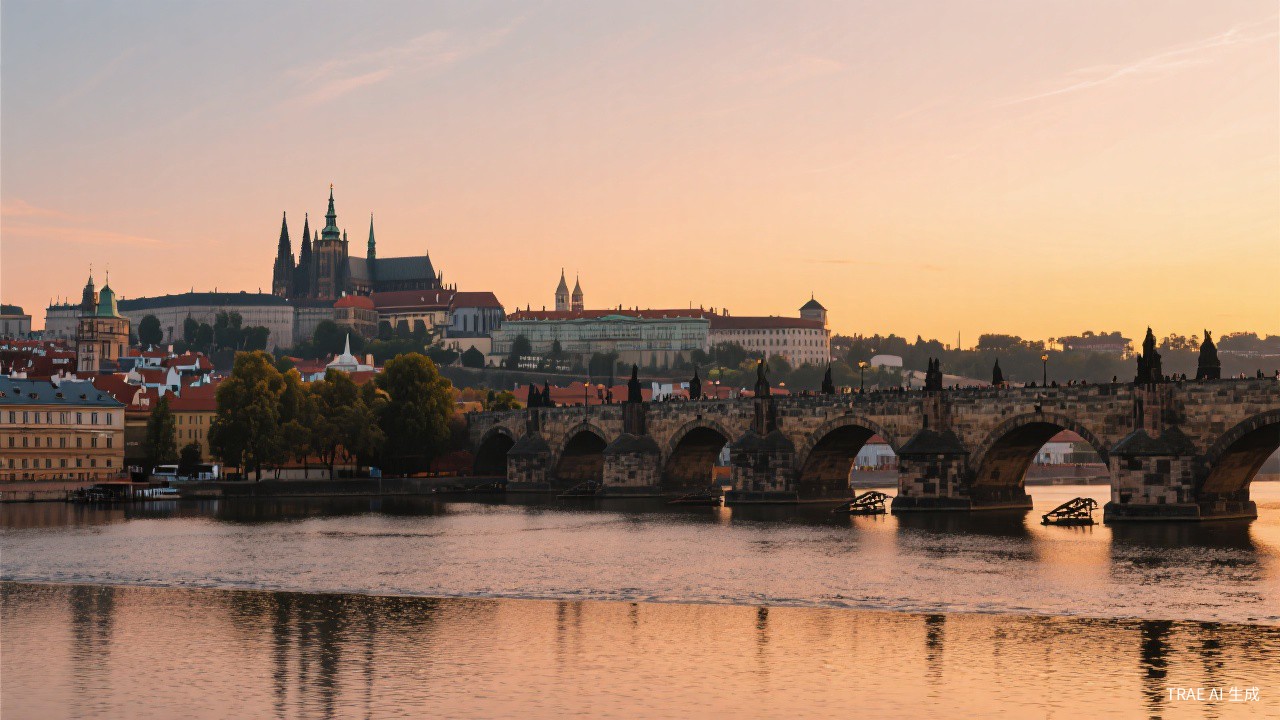
Prague is one of Europe's best-preserved medieval cities, its skyline a jumble of Gothic spires, Baroque domes, and Art Nouveau facades. Charles Bridge, lined with 30 Baroque statues, crosses the Vltava River between the Old Town and the Lesser Town, and has been a pedestrian thoroughfare since 1965. Prague Castle, the largest ancient castle complex in the world, dominates the hill above the Lesser Town and contains St. Vitus Cathedral—a Gothic masterpiece that took nearly 600 years to complete. The Old Jewish Cemetery, with tombstones dating to the 15th century, is one of the oldest surviving Jewish burial grounds in Europe.
Prague has a rich cultural life that extends beyond its architecture. The city has been home to Kafka, Dvorak, and Mucha, and their legacies are visible in museums, concert halls, and Art Nouveau buildings throughout the center. The pub culture is legendary—Czechs drink more beer per capita than any other nationality, and Prague's beer halls serve fresh pilsner and dark lager for under €2 a half-liter. The Vltava riverfront comes alive in summer with outdoor bars and paddle boats shaped like swans.
Three to four days is ideal. Day one: Old Town Square, Astronomical Clock, and Jewish Quarter. Day two: Prague Castle, Lesser Town, and Charles Bridge. Day three: Petrin Hill, Vysehrad Castle, and the Vltava riverfront. Day four: day trips to Kutna Hora (bone church) or Karlovy Vary (spa town). Prague is very walkable.
Best Time to Go
April to June and September to October offer the best weather, with temperatures from 12 to 24 degrees. Spring brings blooming gardens and the Prague Spring International Music Festival. September has warm days, fewer tourists, and the Signal Festival of light art. These months offer the best balance of weather and crowds.
December is magical—the Christmas markets on Old Town Square and Wenceslas Square are among Europe's finest. Winter temperatures drop to -5 to 5 degrees, but the medieval pubs are warm. July and August are warm (20 to 30 degrees) and crowded. The Prague Proms festival runs through summer.
Getting There and Around
Vaclav Havel Airport (PRG) is 15 kilometers west. The Airport Express bus runs to the main station in 35 minutes for 60 CZK (€2.40). Taxis cost about 500 CZK (€20). The 119 bus connects to Dejvicka metro station for 32 CZK (€1.30).
Prague's metro has three lines covering the center. A single ticket is 32 CZK (€1.30), and a 72-hour pass is 310 CZK (€12.40). Tram 22 follows a scenic route through the Lesser Town to Prague Castle. The city is compact and very walkable—most attractions are within a 20-minute walk of Old Town Square.
Where to Stay
The Old Town (Stare Mesto) is the most convenient base. Hotels start at €50 to €200 per night. The area around Old Town Square and Wenceslas Square puts you within walking distance of most attractions. Dlouha Street has good restaurants and a more local feel.
The Lesser Town (Mala Strana) is quieter and more romantic. Hotels start at €70 to €250 per night. The cobblestone streets and Baroque architecture are beautiful, and you are a short walk from Prague Castle. Kampa Island, below Charles Bridge, is particularly peaceful.
Vinohrady and Zizkov, east of the center, offer better value and a more local experience. Hotels start at €40 to €120 per night. Vinohrady has elegant Art Nouveau buildings and excellent restaurants. Zizkov is rougher but has the best pub culture in Prague.
Must-See Attractions
Charles Bridge
A 516-meter stone bridge completed in 1402, lined with 30 Baroque statues of saints. The bridge connects the Old Town to the Lesser Town and offers views of the castle, the river, and the city's spires. Go at sunrise (around 5 AM in summer) for an almost empty bridge and the best light. The Old Town Bridge Tower at the eastern end has an observation gallery.
Tickets: Free; tower 130 CZK (€5) | Open: Always open; tower 10 AM to 10 PM
St. Vitus Cathedral
The centerpiece of Prague Castle, this Gothic cathedral was begun in 1344 and not fully completed until 1929. The interior contains the tomb of St. Wenceslas, the Czech crown jewels (displayed only on special occasions), and stained glass windows by Alphonse Mucha. The rose window above the entrance is one of the largest in Europe.
Entry: Free (part of castle circuit) | Open: 9 AM to 4 PM Monday to Saturday; noon to 4 PM Sundays
Old Jewish Cemetery and Jewish Museum
The oldest surviving Jewish burial ground in Europe, with tombstones dating to 1439. The cemetery contains 12,000 visible tombstones and an estimated 100,000 burials in layers. The adjacent Jewish Museum includes the Old-New Synagogue (Europe's oldest active synagogue, from 1270), the Spanish Synagogue with its Moorish interior, and exhibitions on Jewish life in Bohemia.
Admission: Combined ticket 500 CZK (€20) | Times: 9 AM to 4:30 PM, closed Saturdays
Astronomical Clock
Mounted on the southern wall of the Old Town Hall, this clock dates to 1410 and is the oldest astronomical clock still operating. Every hour, the 12 apostles appear in windows above the clock face, and a skeleton rings a bell. The calendar dial below shows the months and zodiac signs. The clock has been repaired many times—the apostles were added in 1865.
Entry: Free to view; tower 250 CZK (€10) | Times: Tower 9 AM to 9 PM
Vysehrad Fortress
A 10th-century fort on a cliff above the Vltava River, offering panoramic views of Prague. The site includes the Church of St. Peter and St. Paul (with Art Nouveau interior mosaics), the Vysehrad Cemetery (where Dvorak, Smetana, and Mucha are buried), and the Devil's Pillar—a legend says the devil threw it here in a rage. The park is free and peaceful.
Entry: Free | Times: Always open; church 10 AM to 6 PM
Food and Drink
Goulash at U Fleku — Beef goulash with dumplings, served in a 500-year-old brewery restaurant. U Fleku has been brewing dark lager since 1499 and serves it alongside traditional Czech dishes. The medieval courtyard and cellar rooms are atmospheric. The goulash is rich and filling.
Pilsner Urquell at U Medvidku — This 15th-century pub near Wenceslas Square serves tank Pilsner Urquell alongside house-brewed beer. The interior is dark wood and low ceilings—exactly what a medieval pub should feel like. A half-liter costs about 55 CZK (€2.20).
Chimney Cake (Trdelnik) — A cylindrical pastry roasted over an open flame and coated in cinnamon sugar. Available throughout Prague from street vendors. The version at Good Food bakery near Charles Bridge is made with higher-quality dough and has a better texture than the mass-produced versions.
Roast Pork at Lokal Dlouhaaa — Slow-roasted pork shoulder with crispy skin, served with dumplings and red cabbage. Lokal is a modern take on the traditional Czech hospoda, with an emphasis on local ingredients and honest cooking. The portions are large and the prices are fair.
Practical Tips
• The Czech Republic uses the koruna (CZK). Avoid exchanging money at airport kiosks—use ATMs.
• Prague is very affordable compared to Western Europe. A good meal costs €8 to €12.
• Charles Bridge is best at sunrise. By 9 AM it is packed with tourists and vendors.
• The 72-hour transit pass (310 CZK) is the best value for public transport.
• Watch for pickpockets on Charles Bridge and in the Old Town. Keep your phone secure.
Traveler's Tip
Walk from Prague Castle down through the Lesser Town, across Charles Bridge, and through the Old Town to Wenceslas Square at sunset. The route covers Prague's most important sights in about 90 minutes, and the golden light on the Gothic spires is unforgettable. End with a beer at U Zlateho Tygra.