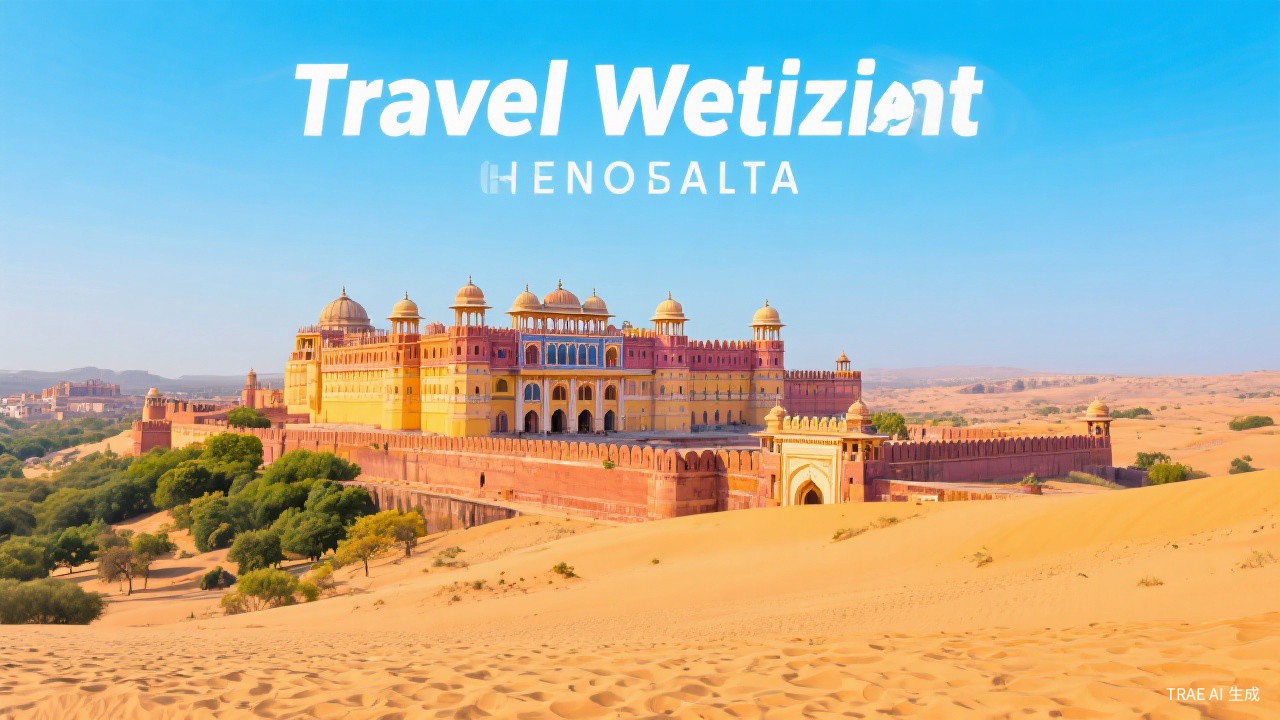
Discovering Rajasthan
Rajasthan is India's most visually striking state, a land of desert forts, painted cities, and camel caravans that once plied the Silk Road. Jaipur, the "Pink City," is dominated by the Hawa Mahal (Palace of Winds) and the Amber Fort, a sprawling hilltop complex that blends Hindu and Mughal architecture. Udaipur, the "City of Lakes," is home to the Lake Palace, a white marble hotel that appears to float on Pichola Lake. Jodhpur, the "Blue City," is backed by the massive Mehrangarh Fort, while Jaisalmer rises from the Thar Desert like a golden sandcastle. Each city has a distinct color scheme, cuisine, and cultural identity.
Rajasthan's warrior heritage is visible in every fort and palace. The Rajput kings who ruled the state built some of India's most elaborate forts, many of which are now UNESCO World Heritage Sites. The state's folk traditions include puppet shows, ghoomar dance performances, and the Manganiyar musicians of western Rajasthan, whose haunting melodies have gained international recognition. The textile traditions—block printing in Jaipur, tie-dye in Jodhpur, and mirror-work embroidery in Jaisalmer—are among India's finest. The camel fairs of Pushkar (November) and Bikaner (January) bring the desert to life.
Plan 10 to 14 days for a complete Rajasthan circuit. Start in Delhi, then Jaipur (2 days), Pushkar (1 day), Jodhpur (2 days), Jaisalmer (2 days), Udaipur (2 days). Add Ranthambore National Park (2 days) for tiger safaris. The distances between cities are large—overnight trains or domestic flights can save time.
Best Time to Go
October to March is the best time, with temperatures between 15 and 30 degrees Celsius. November is ideal—the Pushkar Camel Fair, the weather is pleasant, and the days are sunny. December and January can be cold at night (5 to 10 degrees), especially in the desert. The Jaipur Literature Festival in January is one of the world's largest free literary events.
April to June is brutally hot (40 to 50 degrees) and should be avoided. July to September brings the monsoon, with temperatures dropping to 30 to 38 degrees and the desert briefly turning green. Some hotels offer steep discounts during the monsoon. The monsoon is the quietest time to visit the forts.
Getting There and Around
Jaipur Airport (JAI) has direct flights from Delhi (1 hour), Mumbai (2 hours), and several other Indian cities. Udaipur (UDR) and Jodhpur (JDH) also have airports with connections to Delhi and Mumbai. The Shatabdi Express train connects Delhi to Jaipur in 4.5 hours. The overnight sleeper from Delhi to Jodhpur takes 10 hours. Hiring a private car with driver costs INR 3,000 to 5,000 per day and is the most practical way to cover the Rajasthan circuit.
Within cities, auto-rickshaws cost INR 50 to 200 per trip. Taxis are available but more expensive. In Jaipur, the metro connects some areas. In Jaisalmer, camel carts are a tourist novelty. For the Thar Desert, camel safaris cost INR 500 to 2,000 per person depending on duration. Domestic flights between Jaipur, Jodhpur, and Udaipur cost INR 2,000 to 5,000 and save hours of driving.
Where to Stay
Jaipur has the widest range, from the Rambagh Palace (INR 25,000 to 50,000 per night), a former royal residence, to mid-range hotels like the Alsisar Haveli (INR 4,000 to 8,000). The Nahargarh Fort area has boutique hotels with fort views. Udaipur's Lake Palace (INR 40,000+) is one of the world's most photographed hotels, while the Jagat Niwas (INR 3,000 to 6,000) offers lake views at a fraction of the price.
Jodhpur has the Raas Hotel (INR 10,000 to 20,000), a converted haveli near Mehrangarh Fort, and budget options in the clock tower area (INR 800 to 2,000). Jaisalmer's fort contains heritage hotels like the Dholamar Guest House (INR 1,500 to 3,000) inside the living fort walls. For a desert experience, tented camps near Sam Sand Dunes (INR 3,000 to 8,000) offer camel safaris and cultural performances.
Must-See Attractions
Amber Fort, Jaipur
This massive hilltop fort, 11 kilometers from Jaipur, was built in 1592 by Raja Man Singh I. The fort complex includes the Sheesh Mahal (Hall of Mirrors), where a single candle flame reflects in thousands of tiny mirrors, and the Ganesh Pol gateway with its painted frescoes. The fort is connected to Jaigarh Fort above by a series of tunnels. An elephant ride to the fort gate is available but controversial—walk or take a jeep instead.
Entry: INR 200 (foreigners); INR 100 (Indians) | Times: Daily 8 AM-5:30 PM
Mehrangarh Fort, Jodhpur
Rising 125 meters above Jodhpur's blue-painted old city, Mehrangarh is one of India's most imposing forts. Built in the 15th century, the fort contains palaces with carved sandstone screens, a museum of Rajput weaponry and costumes, and views that stretch across the Thar Desert. The Chamunda Devi Temple and Rao Jodha Rock Park at the base add to the experience.
Entry: INR 600 (foreigners) | Open: Daily 9 AM-5 PM
City Palace and Lake Palace, Udaipur
The City Palace complex, built over 400 years, is the largest palace complex in Rajasthan. It contains museums with miniature paintings, royal costumes, and weapons. The Lake Palace (now the Taj Lake Palace hotel) sits on Jag Niwas Island in Pichola Lake and appears to float on the water. Boat rides on the lake (INR 400) pass both the Lake Palace and Jag Mandir.
Cost: City Palace INR 300; boat INR 400 | Hours: Daily 9:30 AM-5 PM
Jaisalmer Fort and Old Town
This "living fort," built in 1156, is one of the few forts in the world where people still live within its walls. The narrow lanes contain Jain temples with detailed carvings, havelis (merchant mansions) with ornate facades, and rooftop restaurants with views of the surrounding desert. The Patwon Ki Haveli is the most elaborate, with five suites and detailed stone carvings.
Cost: INR 200 (foreigners) | Times: Daily 8 AM-6 PM
Ranthambore National Park
A top places in India to see Bengal tigers in the wild. The park, 130 kilometers from Jaipur, covers 392 square kilometers of dry deciduous forest centered on the 10th-century Ranthambore Fort. Safari drives (3 hours each) take place in open-topped jeeps and canter buses. Besides tigers, the park has leopards, sloth bears, and over 300 bird species.
Tickets: Safari INR 1,000-2,500 (foreigners); guide INR 500 | Times: Safaris 6 AM and 2:30 PM (Oct-Jun)
Food and Drink
Dal baati churma (wheat balls, lentils, and sweet crumble) — Niros Restaurant, Jaipur. INR 300-500.
Laal maas (fiery Rajasthani mutton curry) — Handi Restaurant, Jodhpur. INR 350-500.
Mirchi vada (stuffed chili fritters) and pyaaz kachori — Rawat Mishtan Bhandar, Jaipur. INR 30-80.
Thali (Rajasthani platter with multiple dishes) — Chokhi Dhani, Jaipur. INR 800-1,200.
Practical Tips
• Hire a private car with driver for the Rajasthan circuit—it is the most practical way to cover the long distances.
Book Ranthambore safaris online at least 60 days in advance; permits sell out quickly.
• The Pushkar Camel Fair in November is spectacular but accommodation books out months ahead.
• Drink only bottled water in Rajasthan—tap water is not safe anywhere in the state.
• Bargaining is expected in markets—start at one-third of the asking price for textiles and jewelry.
Traveler's Tip
Visit the Stepwell (Panna Meena Ka Kund) in Amber, just below the Amber Fort in Jaipur. This 16th-century stepwell, with its symmetrical geometric staircases, stands out as photogenic structures in India. It is rarely crowded, and the morning light creates striking patterns on the sandstone steps.