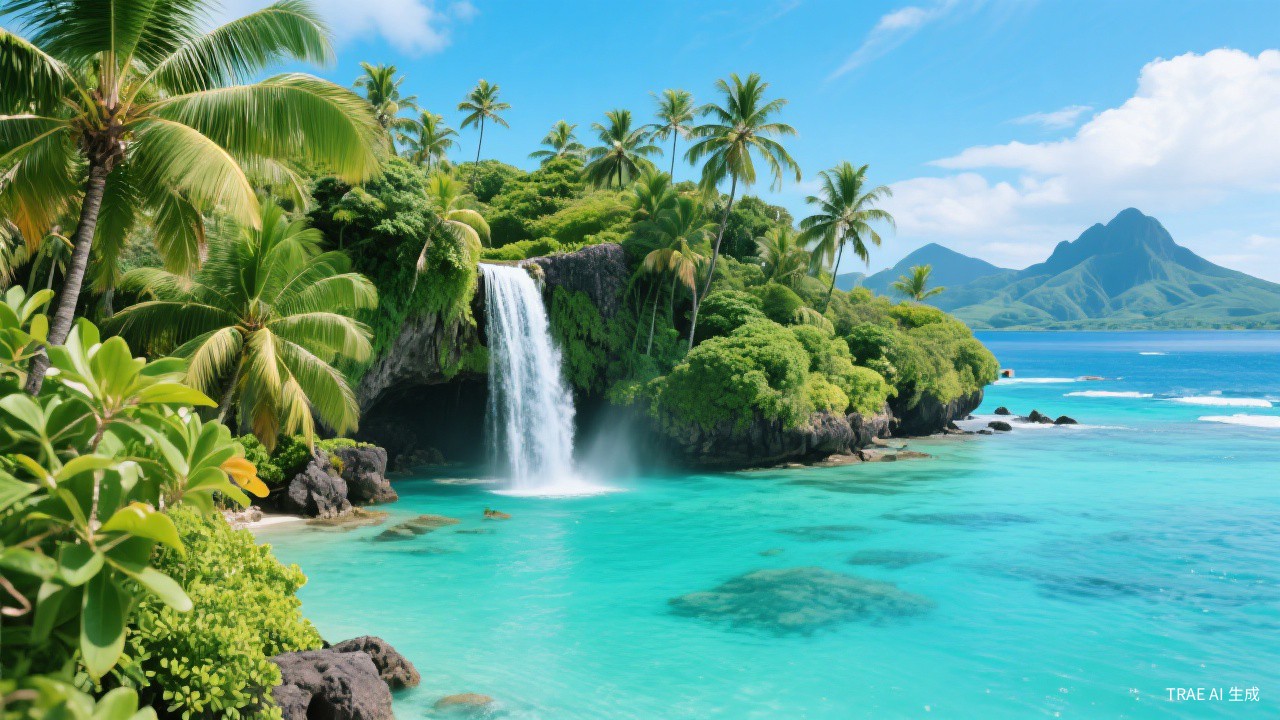
First Impressions of Tahiti
Tahiti is the largest island in French Polynesia, a French overseas territory scattered across the South Pacific. The island is actually two volcanic peaks connected by a narrow isthmus—Tahiti Nui (the larger, western section) and Tahiti Iti (the smaller, eastern peninsula). The capital, Papeete, sits on the northwest coast and serves as the gateway for nearly every visitor arriving in the archipelago. What defines Tahiti worth visiting is not just the postcard lagoons and overwater bungalows the region is famous for, but the island's own raw, volcanic terrain, its busy markets, and a culture that blends Polynesian tradition with French colonial influence in a way you will not find anywhere else in the Pacific.
The island's interior is a dense, mountainous rainforest that most tourists never explore. Waterfalls pour off basalt cliffs into pools surrounded by ferns and breadfruit trees. The roads wind along the coast past black sand beaches, through small villages where roosters wander the streets, and past roadside stands selling tropical fruit. This is not the manicured resort experience of nearby Bora Bora or Moorea. Tahiti has a grittier, more lived-in quality that rewards travelers who take the time to look beyond the airport transfer and the hotel lobby.
French Polynesia's culture is deeply Polynesian at its root, with a French layer on top. You will hear Tahitian spoken alongside French, see traditional tattooing practiced alongside Parisian-style cafes, and eat food that mixes raw fish marinated in coconut milk with fresh baguettes from the bakery. The Heiva festival each July fills the streets with dancing, drumming, and athletic competitions. For travelers who want more than a beach holiday—who want to understand how people live in this part of the world—Tahiti provides a genuine, accessible window into Pacific island life.
Best Time to Go
The dry season from May to October is the most comfortable time to visit. Temperatures hover between 75-85°F with lower humidity and minimal rainfall. July is peak season because of the Heiva festival, which brings traditional dance competitions, canoe races, and craft fairs to Papeete. August is also busy with French school holidays. To attend Heiva, book accommodations months in advance—hotels fill up quickly across the island.
The wet season from November to April brings higher temperatures (85-90°F), heavier rainfall, and increased humidity. December to March is cyclone season, though direct hits on Tahiti are rare. The upside of visiting during the wet season is lower prices and fewer tourists. The water is warm year-round for swimming and diving, and the lagoon is calmest during the warmer months. If you do not mind afternoon rain showers, January through March can be a good budget option.
Getting There and Around
Faa'a International Airport (PPT), located just outside Papeete, is the only international airport in French Polynesia. Air Tahiti Nui flies direct from Los Angeles (about 8 hours), Paris (about 22 hours with a stop), Auckland, and Tokyo. Air France also operates the Paris route. Hawaiian Airlines flies from Honolulu. From the US West Coast, the overnight flight arrives early in the morning, which works well for hotel check-in. There is no direct service from mainland Asia or South America—connections go through Auckland, Los Angeles, or Tokyo.
Once on Tahiti, renting a car is the most practical way to explore. The main road circles Tahiti Nui in about two and a half hours of driving. Rental cars cost roughly 8,000-12,000 CFP francs per day ($75-110 USD). Taxis are expensive and not practical for sightseeing. The local bus system, Le Truck, runs along the coastal road but has no fixed schedule—it departs when full. For getting to Moorea, the ferry from Papeete takes 30 minutes and costs about 1,500 CFP francs ($14 USD) one way, with departures every hour or two from early morning to late afternoon.
Where to Stay
Papeete and surrounding areas offer the most convenient base for first-time visitors. The InterContinental Tahiti Resort & Spa is the largest resort on the island, located near the airport with an overwater bungalow option, a lagoonarium, and multiple restaurants. Rates start at $250-500 per night. Smaller hotels and guesthouses in downtown Papeete cost $80-150 per night and put you within walking distance of the market and waterfront. The downtown area is noisy and not particularly scenic, but it is functional and well-located.
Punaauia and Paea, on the west coast south of Papeete, have several mid-range resorts with beach access and lagoon views. The Manava Suite Resort and the Tahiti Pearl Beach Resort are popular options in the $180-350 range. This coast gets more sun than other parts of the island and has calmer water for swimming. It is about a 15-20 minute trip from Papeete.
Tahiti Iti, the southeastern peninsula, is where you go for quiet and natural beauty. There are a handful of small pensions and guesthouses—no large resorts. Expect to pay $100-200 per night for a simple but comfortable room. The Taravao area, where the two parts of the island connect, has a few more options. Staying on Tahiti Iti makes sense if you plan to hike, surf, or explore the coast without returning to Papeete each day.
Must-See Attractions
Fautaua Waterfall
Fautaua Valley is home to several waterfalls, the most impressive being the 300-foot La Fautaua cascade. The trail passes through lush rainforest with bamboo, ferns, and towering trees before reaching the main falls. A permit is required and can be obtained from the town hall in Papeete for a small fee. The hike takes roughly 2-3 hours round trip and involves some steep, muddy sections. Wear sturdy shoes and bring insect repellent. The pool at the base of the falls is deep enough for swimming when water levels are safe. Go early in the morning before tour groups arrive.
Cost: 500 CFP ($5 USD) permit | Times: Mon-Sat, 7:30 AM-3:30 PM (permit required)
Arahoho Blowhole
Located on the northeast coast of Tahiti Nui, this natural blowhole shoots seawater high into the air through a hole in the volcanic rock. The spray is most dramatic when waves are large, which is more common during the wet season. There is a small parking area and a viewing fence, but no entrance fee. The site is a quick stop—plan 15-20 minutes. The coastal road here is winding and scenic, with views of the ocean crashing against the black lava rocks. Combine this stop with a travel around the east coast for a half-day excursion.
Cost: Free | Times: Always accessible
Pointe Venus
This black sand beach on the north coast is named after Captain Cook's observation of the transit of Venus in 1769. The beach is wide and shaded by palm trees, with a lighthouse at one end. The sand gets very hot in midday sun, so bring sandals. Swimming is possible when the water is calm, though currents can be strong. The nearby James Norman Hall Home, where the American co-author of 'Mutiny on the Bounty' lived, is open for visits and gives a sense of what expatriate life was like in the early 20th century. Pointe Venus is about a 20-minute trip from Papeete.
Tickets: Free (James Norman Hall Home: 500 CFP) | Open: Beach always open; Hall home Tue-Sat 9 AM-4 PM
Musee de la Perle
The Pearl Museum in Papeete is dedicated to the history and science of pearl cultivation in French Polynesia. Exhibits cover the biology of the black-lipped oyster, the grafting process that creates pearls, and the grading system used to evaluate them. You will learn why Tahitian pearls come in such unusual colors—grey, green, blue, bronze—and how to distinguish natural from cultured pearls. The museum is small but well-organized, and a visit takes about 45 minutes to an hour. There is a gift shop selling loose pearls and finished jewelry at fixed prices. Located in the center of Papeete, it is easy to combine with a visit to the market.
Cost: 600 CFP ($5.50 USD) | Hours: Mon-Fri 8:30 AM-4:30 PM, Sat 8:30 AM-12 PM
Marche de Papeete
The central market in Papeete is the social and commercial heart of the island. The ground floor sells fresh produce—tropical fruits, root vegetables, and herbs you will not recognize. Upstairs, vendors sell black pearls, pareos (wraparound garments), wood carvings, and vanilla beans. The food stalls on the ground floor serve local dishes at reasonable prices. The market is busiest on Saturday mornings when families come to shop and socialize. Go early in the day before the heat sets in and before some vendors close in the afternoon. The building itself is a concrete structure from the 1980s, not architecturally notable, but the activity inside is genuine.
Admission: Free to enter | Open: Sun-Thu 6 AM-2 PM, Fri 6 AM-6 PM, Sat 5 AM-2 PM
Food and Drink
Poisson Cru — The national dish of French Polynesia. Raw tuna diced and marinated in lime juice and coconut milk, mixed with diced cucumber, tomato, and onion. The acid in the lime juice partially cooks the fish, similar to ceviche. Every restaurant on the island serves it, but the versions at the food stalls in Marche de Papeete are the most authentic and affordable—expect to pay 800-1,200 CFP ($7-11 USD). The roulottes (food trucks) along the Papeete waterfront also serve excellent poisson cru in the evening for similar prices.
French Pastries and Baguettes — The French colonial legacy means Tahiti has legitimate bakeries. Baguettes are sold warm from the oven at boulangeries across the island, and a fresh baguette costs about 100 CFP (less than $1 USD). Croissants, pain au chocolat, and fruit tarts are widely available. The Chinese grocery stores (the Chinese community has been in Tahiti for generations) also sell French-style pastries alongside Asian goods. For the best selection, visit the Paofai neighborhood in Papeete where several bakeries are clustered together.
Tropical Fruits — Tahiti grows an abundance of tropical fruit that most visitors have never tried fresh. Breadfruit, which has a starchy texture similar to potato when cooked, is a Polynesian staple. Fe'i bananas (red-skinned, orange-fleshed) are sweeter than standard bananas. Starfruit, guava, papaya, pineapple, and mango are sold at the market and along roadside stands. A pile of mixed fruit at the Marche de Papeete costs 500-1,000 CFP ($5-9 USD). Try the rambutan and longan if they are in season—they are rarely available fresh outside of tropical regions.
Steak Frites — A holdover from French cuisine that is surprisingly good in Tahiti. Local restaurants serve New Zealand beef with french fries and a butter sauce. The quality varies, but places like Le Grillardin in Papeete and the restaurants at the larger resorts do a solid version. Expect to pay 1,800-3,500 CFP ($17-33 USD) depending on the cut and the restaurant. Pair it with a Hinano, the local lager, which costs about 400 CFP ($4 USD) for a bottle.
Practical Tips
• The currency is the CFP franc (XPF). It is pegged to the euro at a fixed rate. Credit cards are accepted at hotels and larger restaurants, but carry cash for the market, food trucks, and small shops. ATMs are available in Papeete.
• Rent a car for at least one full day to travel around Tahiti Nui. The coastal road is well-paved and the scenery changes constantly—black sand beaches, waterfalls, small villages, and volcanic peaks. Driving is on the right side, same as in France and the US.
Visit the roulottes (food trucks) along the Papeete waterfront in the evening. They set up around 6 PM and serve a mix of Chinese, French, and Polynesian food at low prices. It is the most authentic dining experience on the island.
• Learn a few words of Tahitian. 'Ia orana' (hello), 'mauruuru' (thank you), and 'nana' (goodbye) go a long way. French is the official language and is spoken everywhere, but locals appreciate the effort.
• If you plan to visit Moorea or other islands, book the inter-island ferry or flights through Air Tahiti in advance. The ferry to Moorea does not require reservations for daytime departures, but seats fill up on weekends and holidays.
Traveler's Tip
Spend your first evening at the roulottes on the Papeete waterfront. Do not overthink which truck to choose—walk the line, look at what people are eating, and pick something that smells good. A plate of poisson cru, a Hinano beer, and a seat on the seawall watching the sunset over Moorea will cost you less than $15 and give you a better sense of daily life in Tahiti than any resort dinner.