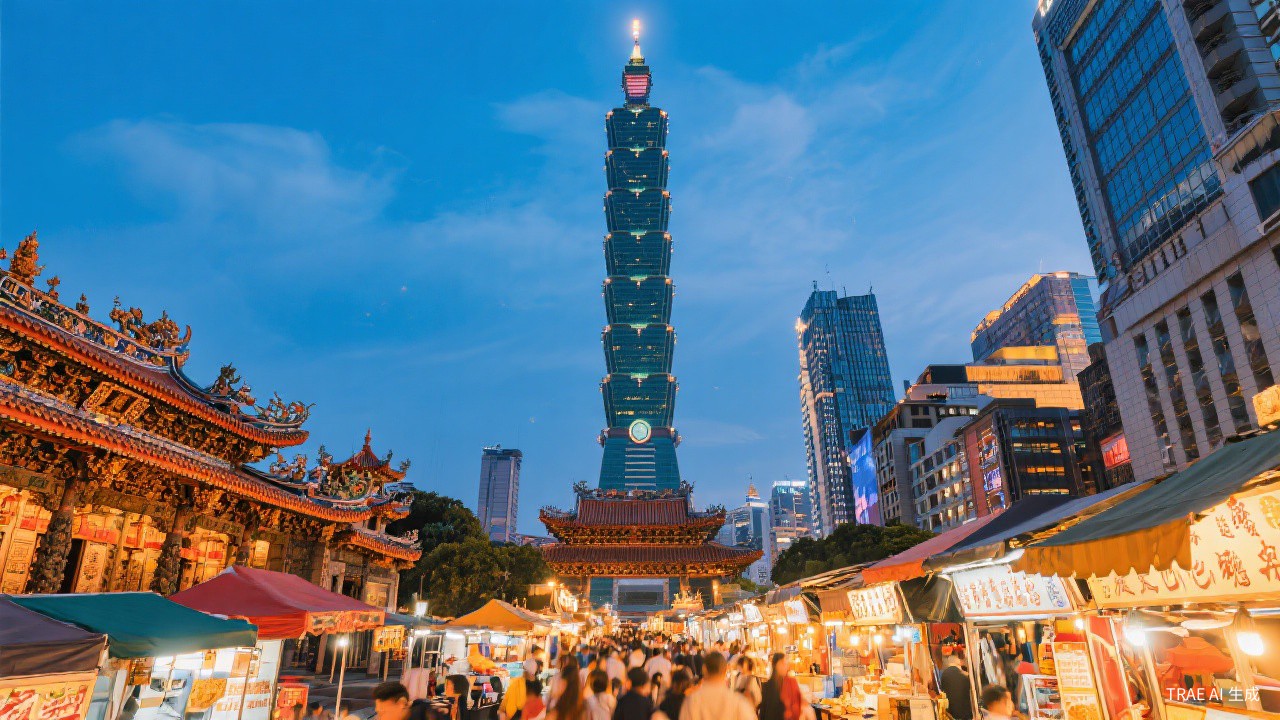
Discovering Taipei
Taipei is a city where ancient Chinese traditions coexist with advanced technology. The National Palace Museum holds the world's largest collection of Chinese imperial artifacts, with nearly 700,000 pieces spanning 8,000 years of history. Taipei 101, standing 508 meters, was the world's tallest building until 2010 and still offers one of the best observation deck experiences in Asia. Longshan Temple, founded in 1738, is one of Taiwan's oldest and most active Buddhist temples, where worshippers pray amid clouds of incense. The city's night markets—Shilin, Raohe, and Tonghua—are legendary for their street food, from beef noodle soup to stinky tofu.
Taipei's quality of life is among the highest in Asia. The MRT (metro) system is clean, efficient, and cheap, with signs in English, Mandarin, and Taiwanese. The city's hot spring culture, centered on the Beitou district in the north, draws visitors to public bathhouses fed by volcanic geothermal activity. The Ximending shopping district is the epicenter of Taiwanese youth culture, with neon lights, street performers, and bubble tea shops on every corner. The city's food culture extends from Michelin-starred restaurants (Taipei has more Michelin-starred eateries than any city in Asia except Tokyo) to humble noodle shops that have operated for decades.
Plan three to four days. Day one: Taipei 101, the National Palace Museum, and Shilin Night Market. Day two: Longshan Temple, Ximending, and Elephant Mountain hike for sunset views. Day three: Beitou hot springs and Yangmingshan National Park. Day four: a day trip to Jiufen (the inspiration for the film "Spirited Away") or the port town of Tamsui.
Best Time to Go
October to April is the most pleasant period, with temperatures between 15 and 25 degrees and low rainfall. The Lantern Festival (February or March) fills the city with elaborate lantern displays. The Taipei International Film Festival in November draws cinema lovers from across Asia.
May to September is hot and humid (28 to 35 degrees) with typhoon season from July to September. The rain can be heavy but usually passes quickly. Summer is also when the night markets are at their liveliest. Winter (December to February) is mild but can be damp.
Getting There and Around
Taoyuan International Airport (TPE) is 40 kilometers west of Taipei. The Taoyuan Airport MRT reaches Taipei Main Station in 35 minutes for TWD 160. A taxi costs TWD 1,100 to 1,500. The airport receives direct flights from cities across Asia, North America, and Europe. Songshan Airport (TSA) in central Taipei handles domestic flights and some regional routes to Japan and China.
The Taipei MRT is one of Asia's best metro systems—clean, efficient, and cheap (TWD 20 to 65 per ride). An EasyCard (TWD 100 deposit) works on the MRT, buses, and YouBike bike-sharing system. Taxis start at TWD 70 and are plentiful. The YouBike system charges TWD 5 for the first 30 minutes. Walking is feasible in the central areas.
Where to Stay
Ximending and the Taipei Main Station area offer the most convenient locations. The CitizenM (TWD 2,500 to 4,000 per night) and the Cosmos Hotel (TWD 2,000 to 3,500) are near the MRT. The East District (Da'an) has boutique hotels like the Eslite Spectrum (TWD 3,000 to 5,000) and excellent restaurants. Zhongshan has the W Hotel (TWD 6,000+) and several mid-range options.
Beitou has hot spring hotels like the Spring City Resort (TWD 3,000 to 5,000), where rooms include private hot spring baths. For budget travelers, hostels in the Ximending area offer dorm beds from TWD 500 to 800. The Dadaocheng area, near Longshan Temple, has heritage boutique hotels like the Dandy Hotel (TWD 2,500 to 4,000).
Must-See Attractions
National Palace Museum
Holding nearly 700,000 pieces of Chinese imperial art and artifacts, this museum has one of the finest collections in the world. Highlights include the Jadeite Cabbage, a piece of jade carved into a head of cabbage with insects, and the Meat-shaped Stone, a piece of jasper carved to resemble a piece of braised pork. The museum's scope spans painting, calligraphy, bronzes, and ceramics from the Neolithic period to the Qing Dynasty.
Tickets: TWD 350 | Open: Daily 8:30 AM-6:30 PM (closed Mon)
Taipei 101
Standing 508 meters with 101 floors, Taipei 101 was the world's tallest building from 2004 to 2010. The observatory on the 89th floor offers views of the city and, on clear days, the mountains surrounding the Taipei Basin. The building's design incorporates traditional Chinese elements—the eight sections of the tower represent the eight trigrams of the I Ching. The tuned mass damper on the 87th floor stabilizes the building against typhoons and earthquakes.
Cost: Observatory TWD 600 | Hours: Daily 9 AM-10 PM
Longshan Temple
Founded in 1738, Longshan Temple is one of Taiwan's oldest and most important Buddhist temples. The temple is dedicated to Guanyin (the Goddess of Mercy) and features ornate roof carvings, bronze dragon pillars, and a constant stream of worshippers. The temple survived Allied bombing in WWII and a fire in the 1940s, and remains an active place of worship.
Tickets: Free | Times: Daily 6 AM-10 PM
Elephant Mountain (Xiangshan)
A short but steep hike (20 to 30 minutes) from the Xiangshan MRT station leads to a viewing platform with one of the best views of the Taipei skyline, including Taipei 101. The hike involves stone steps and some scrambling but is manageable for most fitness levels. Sunset is the most popular time—the city lights begin to glow as the sun drops behind the mountains.
Entry: Free | Hours: Always open; best at sunset
Beitou Hot Springs
The Beitou district in northern Taipei has been a hot spring destination since the Japanese colonial era. The Thermal Valley emits sulfurous steam at 80 to 100 degrees Celsius. Public bathhouses like the Beitou Hot Spring Museum (a restored Japanese-era bathhouse) and the Millennium Hot Spring offer soaking experiences for TWD 40 to 300. Private hot spring hotels are also available.
Tickets: Public baths TWD 40-300 | Times: Museum Tue-Sun 9 AM-5 PM; public baths vary
Food and Drink
Beef noodle soup (niu rou mian) — Lin Dong Fang Beef Noodle Soup, Minsheng East Road. TWD 200-350.
Xiao long bao (soup dumplings) — Din Tai Fung, Taipei 101 basement. TWD 300-500.
Stinky tofu (chou doufu) and fried chicken — Raohe Night Market. TWD 50-100.
Bubble tea (zhen zhu nai cha) — Chun Shui Tang, original bubble tea shop, Taipei. TWD 70-120.
Practical Tips
• Get an EasyCard at any MRT station—it works on trains, buses, and YouBike bike sharing.
• The National Palace Museum is huge—focus on the highlights (Jadeite Cabbage, Meat-shaped Stone) if time is limited.
• Taipei 101 observatory tickets can be bought online to skip the queue.
• Night markets are cheapest after 9 PM when vendors start discounting.
• The Elephant Mountain hike is short but steep—wear comfortable shoes and bring water.
Traveler's Tip
Take the MRT to Tamsui station at the end of the red line (40 minutes from Taipei Main Station). Walk along the Tamsui River waterfront at sunset, eat at one of the fisherman's wharf restaurants, and take the ferry across the river (TWD 60) as the sky turns orange. The view of the Guanyin Mountain from the water is one of Taipei's most peaceful moments.