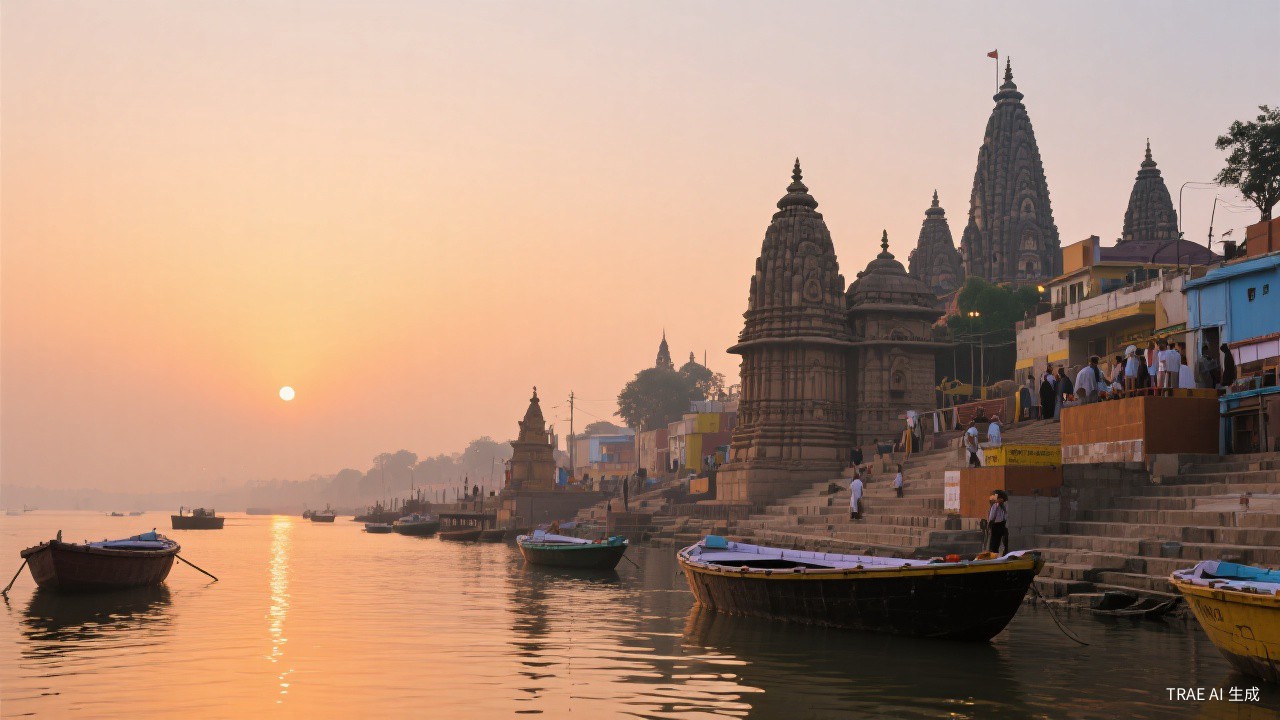
What Makes Varanasi Worth Visiting
Varanasi is the oldest continuously inhabited city in India, sitting on the western bank of the Ganges River in Uttar Pradesh. Hindus consider it the most sacred place on earth, believing that dying here releases the soul from the cycle of rebirth. The city's riverfront is lined with over 80 ghats—stone steps leading down to the water—where pilgrims bathe at dawn, priests perform fire ceremonies at dusk, and cremation fires burn around the clock at Manikarnika and Dashashwamedh ghats. The narrow lanes of the old city, crowded with cows, cycle-rickshaws, and silk merchants, have changed little in centuries.
Life in Varanasi revolves around the Ganges. Every morning before sunrise, boatmen row visitors along the riverfront to watch the pilgrims wade into the water, cup their hands, and pour the river back over their heads. At Dashashwamedh Ghat, the Ganga Aarti ceremony begins each evening at 6:45 PM, when priests in saffron robes wave brass lamps and conch shells toward the river while thousands of spectators fill the steps and boats. The smoke from Manikarnika Ghat, where around 200 bodies are cremated daily, rises above the city day and night—a raw, confronting sight that few visitors forget.
Give Varanasi at least three days. Day one: sunrise boat ride, walk the ghats from Assi to Dashashwamedh, and attend the evening Aarti. Day two: visit Kashi Vishwanath Temple (one of the 12 Jyotirlinga shrines to Shiva), explore the old city lanes, and take a silk-weaving workshop in the weavers' quarter. Day three: Sarnath, 10 kilometers northeast, where the Buddha gave his first sermon after enlightenment. The site contains the Dhamek Stupa, ancient monasteries, and an excellent archaeological museum.
Best Time to Go
October to March is the best time, with daytime temperatures between 15 and 30 degrees Celsius and low humidity. November brings Dev Deepawali, when millions of oil lamps are placed on the ghats—a spectacle that rivals any festival in India. January and February can drop to 5 degrees at night, so pack warm layers for early morning boat rides.
April to June is brutally hot, with temperatures regularly exceeding 40 degrees and the river at its lowest. July to September brings the monsoon, when the Ganges swells and floods the lower ghats. The city takes on a different character during the rains—fewer tourists, lower hotel prices, and a moody, atmospheric quality that photographers love.
Getting There and Around
Lal Bahadur Shastri International Airport (VNS) is 26 kilometers from the city, with direct flights from Delhi (1.5 hours), Mumbai (2 hours), and Kolkata. A prepaid taxi from the airport costs INR 600 to 800. Varanasi Junction railway station connects to Delhi (12 hours by overnight train), Kolkata (12 hours), and Agra (6 hours). The train ride from Delhi passes through the Gangetic plain and is comfortable in first-class AC (INR 2,000 to 3,000).
Within the old city, the only practical transport is on foot—the lanes are too narrow for cars and too crowded for bicycles. Cycle-rickshaws charge INR 30 to 80 for short distances. Auto-rickshaws are useful for reaching Sarnath (INR 200 to 300 one way) or the airport. Boats can be hired at Dashashwamedh Ghat for INR 200 to 500 for a sunrise ride; negotiate firmly and agree on the price before boarding.
Where to Stay
The area around Dashashwamedh Ghat and Godaulia Chowk puts you in the center of the old city, within walking distance of the main ghats and temples. Hotels start at the BrijRama Palace (INR 8,000 to 15,000 per night), a heritage haveli on the riverfront, to simpler guesthouses like Shanti Guest House (INR 800 to 1,500) with rooftop views of the Ganges. The location is noisy and chaotic but unmatched for atmosphere.
Assi Ghat, at the southern end of the riverfront, is quieter and popular with long-stay visitors and yoga students. Guesthouses here cost INR 500 to 2,000 and the area has several good cafes. The Cantonment area, north of the old city, has larger hotels like the Taj Nadesar Palace (INR 25,000+) and the Radisson (INR 5,000 to 8,000) with more space and cleaner air.
Must-See Attractions
Dashashwamedh Ghat and Ganga Aarti
The largest and most active ghat in Varanasi, where the evening Ganga Aarti ceremony has been performed daily for centuries. Seven priests in saffron robes stand on wooden platforms facing the river, waving multi-tiered brass lamps, blowing conch shells, and ringing bells. The ceremony starts at 6:45 PM and lasts 45 minutes. Arrive by 5:30 PM to get a seat on the steps or book a boat (INR 100 to 200) for a river view.
Cost: Free; boat INR 100-200 | Hours: Aarti daily 6:45 PM
Manikarnika Ghat
The main cremation ghat of Varanasi, where around 200 bodies are burned each day on open pyres of wood. The ghat has been used for cremations for over 3,000 years. Visitors can observe from the steps above—photography is considered disrespectful and is not allowed. The atmosphere is intense, smoky, and deeply spiritual. A donation to the Doms (the community that tends the fires) is customary if you spend time watching.
Cost: Free to observe | Hours: Cremations 24 hours
Kashi Vishwanath Temple
One of the 12 Jyotirlinga shrines dedicated to Shiva, this temple sits in the heart of the old city and draws thousands of pilgrims daily. The current structure was built in 1780 by Ahilyabai Holkar of Indore, though a temple has existed on this site for over 1,000 years. The gold-plated spire was donated by Maharaja Ranjit Singh of Punjab. Security is tight—phones, cameras, and bags must be deposited at the entrance (INR 25).
Entry: Free; locker INR 25 | Hours: Daily 3 AM-11 PM
Sarnath Archaeological Site
Ten kilometers northeast of Varanasi, Sarnath is where the Buddha gave his first sermon after attaining enlightenment, setting in motion the "Wheel of Dharma." The site contains the Dhamek Stupa (a 43-meter brick structure dating to 500 AD), the remains of ancient monasteries, and the Ashoka Pillar with its four-lion capital (now India's national emblem). The adjacent archaeological museum houses the famous Ashoka Lion Capital and other artifacts from the Mauryan and Gupta periods.
Tickets: Site INR 20; Museum INR 20 | Times: Site daily 9 AM-5 PM; Museum 9 AM-5 PM (closed Fri)
Sunrise Boat Ride on the Ganges
A dawn boat ride along the Varanasi ghats is one of India's most iconic experiences. Boatmen row from Dashashwamedh Ghat south toward Assi Ghat, passing pilgrims bathing in the river, laundry workers beating clothes on stone platforms, and the morning sun turning the water gold. The ride lasts 60 to 90 minutes. The best time to start is 5:30 AM in summer and 6:30 AM in winter.
Tickets: INR 200-500 per boat | Open: Boats from 5 AM
Food and Drink
Kachori sabzi (fried pastry with potato curry) — Kashi Chat Bhandar, Godaulia Chowk. INR 40-60.
Thandai (spiced milk drink with nuts and rose) — Blue Lassi Shop, near Dashashwamedh Ghat. INR 80-150.
Benarasi paan (betel leaf preparation) — Paan vendors near Godaulia Chowk. INR 30-80.
Aloo tikki and chaat — Deena Chaat Bhandar, Lanka Road. INR 40-70.
Practical Tips
• Dress conservatively at Varanasi's temples. Both men and women should cover shoulders and knees. Leather items—belts, shoes, bags—may not be allowed inside some temples. Remove shoes before entering. Photography rules vary by temple; ask before shooting inside.
• Bargain hard for boats at the ghats—start at half the asking price and walk away if needed.
• Manikarnika Ghat is a solemn place—do not take photos and maintain a respectful distance.
• The old city lanes are a maze—download a map or hire a guide (INR 500 to 1,000 for a half-day walk).
• Drink only bottled water in Varanasi—the tap water is not safe for visitors.
Traveler's Tip
Hire a boat at Assi Ghat at 5:30 AM (not Dashashwamedh, which is more crowded and expensive). Row south along the quietest stretch of the riverfront, past Subhash Ghat and Tulsi Ghat, where you will see yoga practitioners on the steps and only a handful of other boats. Ask the boatman to stop at a ghat where you can buy a small diya (oil lamp) and flower basket from a vendor for INR 20—float it on the Ganges as the sun rises over the far bank.