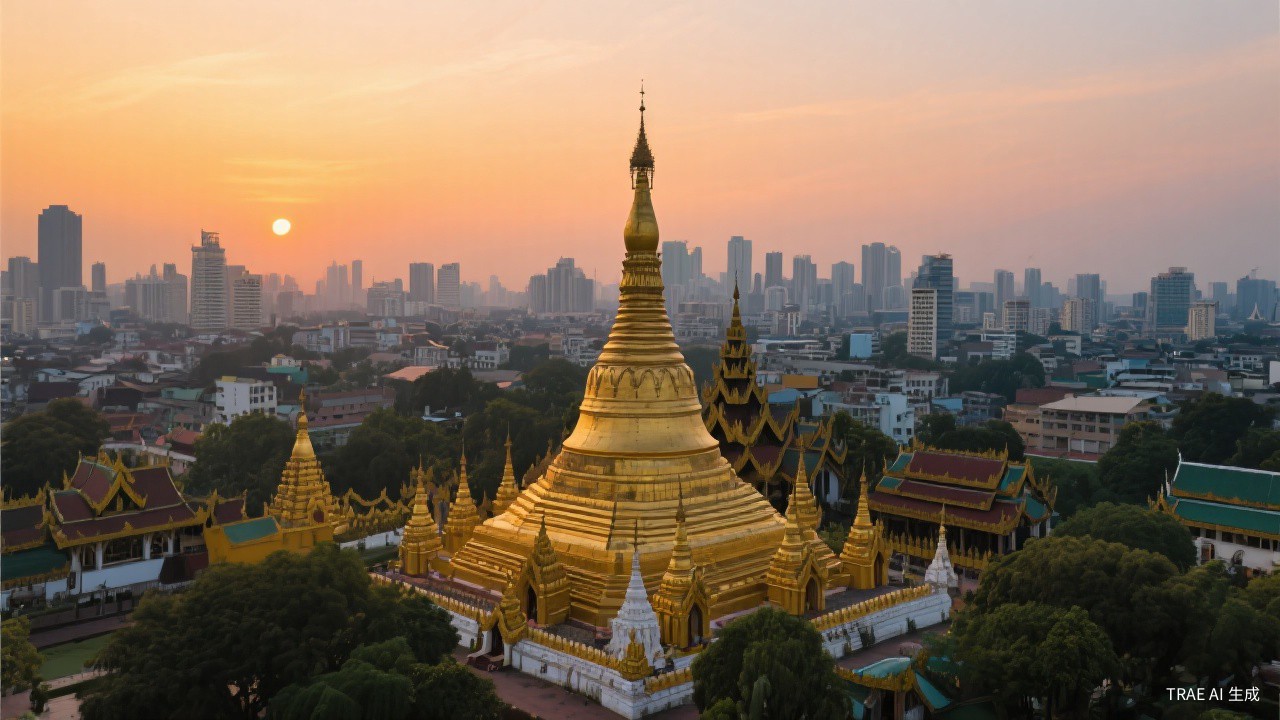
What Makes Yangon Worth Visiting
Yangon is Myanmar's largest city and the home of the Shwedagon Pagoda, a 99-meter gilded stupa that dominates the skyline and serves as the spiritual heart of Burmese Buddhism. Covered in over 60 tons of gold leaf and crowned with a 76-carat diamond, the Shwedagon is visible from nearly every point in the city. But Yangon is more than its most famous monument. The downtown area contains the largest collection of colonial-era buildings in Southeast Asia—crumbling but beautiful structures from the British Raj that house government offices, shops, and apartments. Sule Pagoda, a smaller golden stupa, sits at the center of a traffic roundabout in the middle of the commercial district.
The streets of downtown Yangon feel like a time capsule. Vendors sell betel nut and tea from wooden stalls on the sidewalks, while heritage buildings with wrought-iron balconies line the blocks around Mahabandoola Road. Bogyoke (Scott) Market, housed in a 1920s colonial building, is the best place to buy jade, rubies, longyi (traditional Burmese sarongs), and lacquerware. Kandawgyi Lake, with its royal barge-shaped Karaweik Hall, offers a quiet escape from the city heat. The Yangon Circular Railway, a 46-kilometer loop that takes three hours, passes through suburban neighborhoods, markets, and open fields—a window into daily life that few tourists experience.
Plan three days. Day one: Shwedagon Pagoda at sunrise, then downtown walking tour covering Sule Pagoda, the Strand Hotel, and the colonial buildings along Bank Street. Day two: Bogyoke Market in the morning, the National Museum in the afternoon, and Kandawgyi Lake at sunset. Day three: take the Circular Railway in the morning, visit Chaukhtatgyi Reclining Buddha, and explore the local food stalls around 19th Street in Chinatown.
Best Time to Go
November to February is the cool, dry season, with temperatures between 20 and 32 degrees Celsius and low humidity. This is the best time for temple visits and outdoor exploration. The Shwedagon Pagoda is particularly beautiful in the early morning light during these months. The Yangon Arts and Heritage Festival takes place in January.
March to May is the hot season, with temperatures reaching 40 degrees and high humidity. The Thingyan Water Festival in mid-April turns the entire country into a water fight for four days—expect to get soaked wherever you go. June to October is the rainy season, with heavy afternoon downpours. The rains cool things off but make walking the downtown streets less pleasant.
Getting There and Around
Yangon International Airport (RGN) is 15 kilometers from the city center, with direct flights from Bangkok (1.5 hours), Singapore (3 hours), Kuala Lumpur (2.5 hours), and several Chinese cities. A taxi from the airport costs MMK 8,000 to 12,000 (about USD 5 to 7). The airport taxi counter inside the terminal offers fixed prices. The Yangon Central Railway Station connects to Mandalay (8 hours by express), Bagan (10 hours), and Naypyidaw (4 hours).
Within Yangon, taxis are the most practical option—most trips within the city cost MMK 2,000 to 5,000. Ride-hailing apps like Grab and Oway are available and more reliable than street-hailing. The Yangon Circular Railway costs MMK 200 for a full loop and departs from Central Station every 20 minutes starting at 6 AM. Buses are cheap (MMK 200) but confusing for visitors. Walking is the best way to explore downtown—the area is compact and relatively safe.
Where to Stay
Downtown Yangon around Mahabandoola Road and Sule Pagoda is the most convenient base, with colonial-era hotels like The Strand (USD 300+ per night) and mid-range options like the Clover Hotel (USD 50 to 80). The area puts you within walking distance of Bogyoke Market, the riverfront, and the main pagodas. The colonial architecture and street life make this the most atmospheric area to stay.
The area around Kandawgyi Lake and Shwedagon Pagoda has upscale hotels like the Chatrium (USD 100 to 180) and the Savoy (USD 150 to 250). The lake area is quieter and greener than downtown. For budget travelers, guesthouses in Chinatown near 19th Street offer rooms from USD 15 to 30. The backpacker area around Shwedagon Pagoda has hostels with dorm beds from USD 10 to 15.
Must-See Attractions
Shwedagon Pagoda
Myanmar's most sacred Buddhist site rises 99 meters above Yangon, covered in gold leaf and topped with a 76-carat diamond. The platform at the base contains dozens of smaller shrines, statues, and pavilions, each with its own significance. Visit during is at sunset, when the gold surface glows orange and the city lights flicker on below. The north entrance, with its pair of chinthe (lion) guardians, is the most impressive approach.
Entry: MMK 10,000 (foreigners) | Times: Daily 4 AM-10 PM
Bogyoke (Scott) Market
Housed in a grand 1920s colonial building, Bogyoke Market is Yangon's premier shopping destination. The market sells jade, rubies, sapphires, pearls, lacquerware, longyi, antiques, and wood carvings. Bargaining is expected—start at half the asking price for jewelry. The food court on the ground floor serves Burmese, Chinese, and Indian dishes at local prices.
Cost: Free entry | Open: Tue-Sun 10 AM-5 PM (closed Mondays)
Yangon Circular Railway
This 46-kilometer loop railway takes three hours to complete and passes through neighborhoods, markets, and countryside that tourists rarely see. The train stops at over 30 stations, and vendors board at each stop selling fruit, fried snacks, and tea. The wooden benches and open windows give it an old-world charm. Buy a ticket at Central Station and ride the full loop or get off at interesting stops along the way.
Entry: MMK 200 | Times: First train 6 AM; last train 6 PM
Chaukhtatgyi Reclining Buddha
This 65-meter reclining Buddha image is one of the largest in Myanmar, housed in a large metal-roofed shed. The Buddha's feet are decorated with 108 auspicious symbols in lacquer and gold. The image was rebuilt in 1966 and shows the Buddha in the "relaxing" posture, representing the moment before entering nirvana. The site is much less crowded than Shwedagon.
Entry: MMK 5,000 | Hours: Daily 6 AM-8 PM
Kandawgyi Lake and Karaweik Hall
This artificial lake in central Yangon is surrounded by a shaded walking path and offers views of the Shwedagon Pagoda reflected in the water. The Karaweik Hall, a concrete replica of a royal barge on the eastern shore, contains a restaurant serving Burmese set meals. The sunset views from the boardwalk along the lake's western shore are among the best in the city.
Entry: Free; Karaweik restaurant from MMK 25,000 | Times: Lake always open; Karaweik 11 AM-2 PM, 5-9 PM
Food and Drink
Mohinga (fish noodle soup, Myanmar national dish) — Morning tea shops on Mahabandoola Road. MMK 1,500-3,000.
Burmese tea leaf salad (lahpet thoke) — 999 Shan Noodle House, downtown Yangon. MMK 2,500-4,000.
Shan-style noodles (tohu nway) — Aye Myit Tar, 19th Street Chinatown. MMK 2,000-3,500.
Grilled skewers and Myanmar beer — 19th Street night market, Chinatown. MMK 1,000-3,000.
Practical Tips
• Carry crisp US dollars for visa fees and larger purchases—old, torn, or folded bills are often rejected.
• Remove shoes and socks before entering any pagoda or temple—bring slip-on shoes for convenience.
• The power supply in Yangon has improved but can still be unreliable—carry a flashlight.
• Bargaining is expected at Bogyoke Market—start at half the asking price.
Avoid tap water entirely—drink only bottled or boiled water.
Traveler's Tip
Take the Yangon Circular Railway from Central Station at 3 PM (MMK 200). The three-hour loop passes through Insein, where vendors sell fresh produce from baskets on the platform, and through open fields where children wave from the tracks. The light in the late afternoon turns everything golden, and the slow pace of the train gives you time to watch daily life unfold outside the window. Get off back at Central Station as the sun sets.