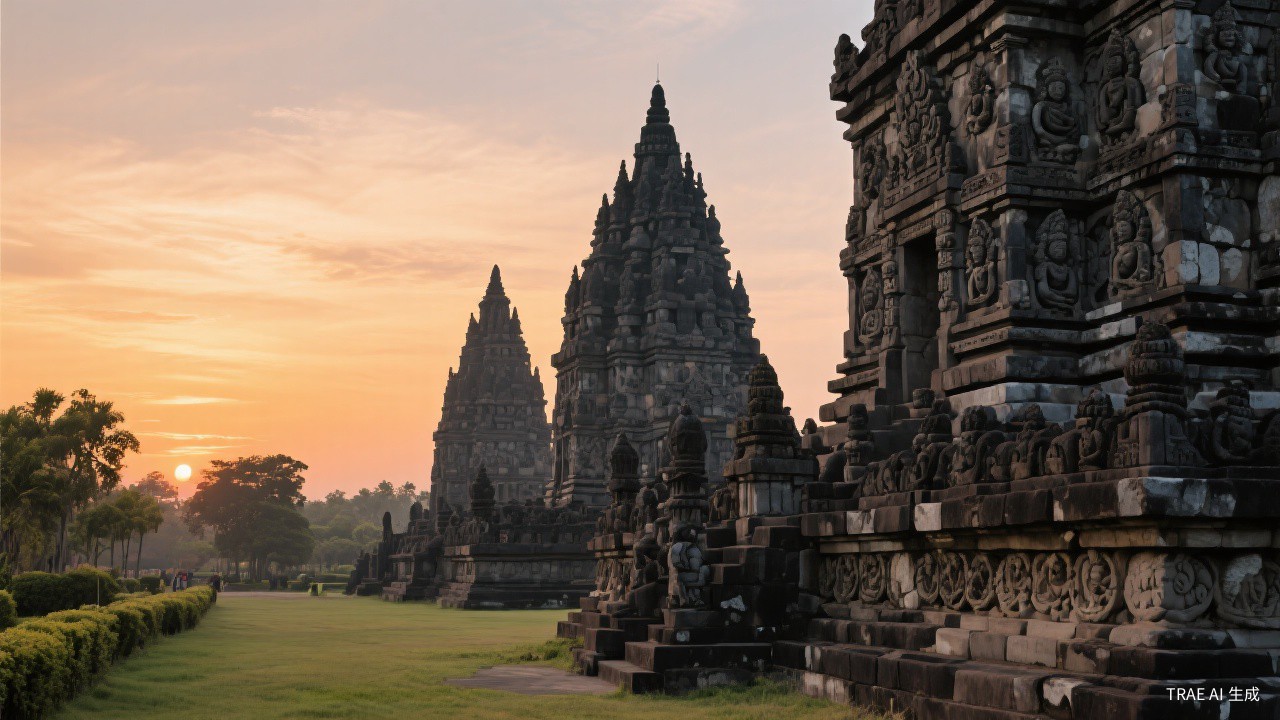
What You Will Find in Yogyakarta
Yogyakarta, known locally as Jogja, is the cultural capital of Java and the only Indonesian province still ruled by a sultan. The Sultan's Palace (Keraton) sits at the center of the city, a walled compound where the current sultan still lives and where traditional Javanese dance, gamelan music, and batik-making are preserved. The city is the gateway to two of Indonesia's most important archaeological sites: Borobudur, the world's largest Buddhist temple, and Prambanan, the largest Hindu temple compound in Southeast Asia. Mount Merapi, Indonesia's most active volcano, smokes on the northern horizon.
Jogja has a youthful energy driven by its large student population—over 100,000 university students live here. The area around Jalan Malioboro, the city's main street, fills each evening with street vendors selling gudeg (young jackfruit stew), batik textiles, and leather shadow puppets. The city's batik workshops, many run by families for generations, produce some of the finest batik in Indonesia. The food scene is excellent and affordable—warungs (small restaurants) serve Javanese cuisine for a fraction of Jakarta prices.
Plan four days. Day one: Keraton, Taman Sari water castle, and Malioboro Street. Day two: Prambanan Temple at sunrise, then the Ratu Boko ruins overlooking the Prambanan plain. Day three: Borobudur Temple for sunrise (book a tour from Jogja). Day four: Mount Merapi jeep tour in the morning, then visit a batik workshop in the afternoon.
Best Time to Go
April to October is the dry season, with temperatures between 24 and 33 degrees Celsius and the least rainfall. May to July is the most pleasant period, with lower humidity and clear skies. The dry season is best for visiting Borobudur at sunrise and for Mount Merapi jeep tours. August can be windy.
November to March is the rainy season, with heavy afternoon downpours. The temples are less crowded during this period, and the surrounding rice paddies are vividly green. January and February are the wettest months. The temperatures remain warm (25 to 31 degrees) but the humidity is high.
Getting There and Around
Adisucipto International Airport (JOG) is 8 kilometers from the city center, with direct flights from Jakarta (1 hour), Bali (1.5 hours), Singapore (2.5 hours), and Kuala Lumpur (2.5 hours). A taxi from the airport to Malioboro costs IDR 60,000 to 80,000. The Yogyakarta International Airport (YIA), 45 kilometers west of the city, handles some domestic flights—a shuttle bus connects it to the city center for IDR 50,000. The train from Jakarta takes 7 to 8 hours (executive class IDR 350,000 to 450,000).
Trans Jogja buses cover the main tourist routes for IDR 3,600 per ride. Becak (cycle rickshaws) charge IDR 15,000 to 30,000 for short trips around the city center. Gojek and Grab are widely available and useful for longer distances. Renting a motorbike costs IDR 70,000 to 100,000 per day. For visiting Borobudur (40 kilometers), Prambanan (17 kilometers), and Mount Merapi, join a tour or hire a car with driver (IDR 500,000 to 700,000 per day).
Where to Stay
The area around Malioboro Street and the Keraton is the most convenient base, with hotels ranging from the Phoenix Hotel (IDR 800,000 to 1,500,000 per night), a colonial-era property, to budget guesthouses like the Batik Guest House (IDR 150,000 to 300,000). The location puts you within walking distance of the palace, the water castle, and the main shopping street.
The Prawirotaman area, south of the city center, has become Jogja's boutique hotel district, with properties like the Dusun Jogja Village Inn (IDR 600,000 to 1,000,000) and several art galleries and cafes. The area is quieter than Malioboro but still well-connected. For budget travelers, hostels in the Sosrowijayan area near Malioboro offer dorm beds from IDR 60,000 to 100,000.
Must-See Attractions
Prambanan Temple Compound
The largest Hindu temple compound in Southeast Asia, built in the 9th century during the Sanjaya Dynasty. The central complex contains three main temples dedicated to Shiva, Vishnu, and Brahma, each 47 meters tall and decorated with detailed reliefs depicting scenes from the Ramayana. The complex originally contained 240 temples, though many are in ruins. The Ramayana Ballet is performed here on full moon nights from May to October.
Tickets: IDR 375,000 (foreigners) | Hours: Daily 6 AM-5 PM
Keraton (Sultan's Palace)
The current sultan's residence and the cultural heart of Yogyakarta. The palace complex contains courtyards, pavilions, and a museum displaying royal regalia, gamelan instruments, and gifts from foreign dignitaries. Traditional Javanese dance and gamelan performances are held daily at 10 AM. The architecture blends Javanese and colonial influences.
Entry: IDR 15,000 | Open: Daily 8:30 AM-1:30 PM
Taman Sari Water Castle
Built in 1758 by Sultan Hamengkubuwono I, this former royal pleasure garden contains a network of pools, tunnels, and underground passages. The central bathing pool was reserved for the sultan's wives and concubines. A guided tour (IDR 50,000) is recommended to Find your way through the labyrinthine passages and hear the stories behind the ruins.
Admission: IDR 15,000; guide IDR 50,000 | Open: Daily 9 AM-3 PM
Mount Merapi Jeep Tour
Mount Merapi (2,930 meters) is Indonesia's most active volcano, with its last major eruption in 2010. Jeep tours from Jogja take visitors to the slopes of the volcano, passing through villages destroyed by pyroclastic flows and the "Museum Sisa Hartaku," where residents display belongings recovered from the eruption. The tours also visit the Bunker Kaliadem observation post.
Admission: IDR 350,000-500,000 per jeep | Times: Tours depart 6-8 AM
Jalan Malioboro
Yogyakarta's most famous street stretches 1 kilometer from the Keraton north to the train station. The sidewalk is lined with vendors selling batik, leather goods, wayang (shadow puppets), and silver jewelry. At night, lesehan (floor seating) restaurants set up along the street, serving gudeg, nasi gudeg, and other Javanese specialties. The atmosphere is lively every evening.
Entry: Free | Hours: Vendors daily 9 AM-10 PM
Food and Drink
Gudeg (young jackfruit stew with coconut milk) — Bu Tjitro Gudeg, Jalan Wijilan. IDR 20,000-35,000.
Bakpia pathok (sweet mung bean pastries) — Bakpia Pathok 25, Jalan Malioboro. IDR 30,000-50,000 per box.
Ayam goreng Kalasan (Kalasan-style fried chicken) — Warung Ayam Goreng Bu Tini, Kalasan area. IDR 25,000-40,000.
Wedang ronde (hot ginger drink with rice balls) — Angkringan stalls, Jalan Malioboro at night. IDR 5,000-10,000.
Practical Tips
Visit Borobudur at sunrise—book a tour from Jogja the day before, as departures start at 4 AM.
• Wear a sarong when entering temples—most sites lend them at the entrance for a small fee.
• Mount Merapi jeep tours can be bumpy—bring a scarf to cover your face from dust.
• The Ramayana Ballet at Prambanan on full moon nights is a highlight—book tickets in advance.
• ATMs are plentiful in Jogja, but carry cash for small purchases and transport.
Traveler's Tip
Visit the Batik Winotosastro workshop on Jalan Tirtodipuran (IDR 50,000 for a 90-minute class). The family has been making batik for five generations, and you will learn the traditional canting (wax pen) technique, drawing patterns on cotton cloth with hot wax before dipping it in natural dyes. You keep the piece you make. The workshop is small, personal, and far more rewarding than buying machine-printed batik on Malioboro.